Tuesday, 28 November 2017

Building a new Olympic Stadium - and Building up National Debt

Right next to Meiji Jingu Gaien (明治神宮外苑), where crowds are currently flocking to check out the beautiful yellowing ginkgo trees, is the National Stadium - or part of it at least. The National Stadium (Kokuritsu Kyōgijō=国立競技場) was originally built in 1958 for the 1964 Tokyo Olympics but, following the announcement that Tokyo had won the 2020 Olympics, plans were made to build a new, bigger stadium to be the main venue for the games. Demolition of the old stadium was completed in May 2015 but the original plans were scrapped only two months late amid a public outcry over skyrocketing costs. New, cheaper bids were invited and construction belatedly began in December 2016. As the picture below shows, work is well under way and the new stadium is scheduled to be ready by November 2019 - unfortunately too late for the Rugby World Cup by a couple of months.
 The controversy over costs - the original stadium, even after refinements, was going to cost some 300 billion million yen (three times the cost of the Olympic Stadium in London) - highlights the public's unease over wasteful public spending. On the other hand, there seems to be little popular concern over Japan's spiralling national debt. The figures are staggering: Japan has the highest ratio of debt to GDP by far at 234.7% (way above Greece in 2nd place). The result is that Japan uses an unbelievable half of all tax revenues to service its debt. This may seem odd given Japan's reputation as a "nation of savers" but it is actually Japan's savers - the people buying government bonds - who have basically funded the nation's huge debt. The worry is that with Japan's household savings rate dropping into negative territory in 2014 for the first time since 1955, coupled with a plummeting population and lack of a migration policy, Japan's national debt is unsustainable. The Olympics is only likely to exacerbate the problem.

Wednesday, 22 November 2017

The Changing Colour of the Leaves, Ginkgo Trees, and Poisonous Nuts

Though not in the same league as cherry-blossom viewing (hanami), at this time of year many Japanese go to see the autumnal leaves beginning to change colour, what is known as kōyō (紅葉). Although this literally means "crimson" or "deep red" leaves, it does in fact refer to any kind of colour change - including yellow. One of the first trees to change are the ginkgo or gingko trees which have already started to display their autumnal yellow. Apparently the English name ginkgo/gingko is a mis-spelling of the Japanese gin-kyō (銀杏)literally meaning "silver apricot." The Japanese don't pronounce the tree this way though - it is pronounced ichō though the kanji is the same. To add to the confusion, the yellow fruit of the tree - that is ginkgo/gingko nuts - also use the same kanji compound which in this case is pronounced gin-nan.

One of the best spots for viewing the ichō trees in Tokyo is the Meiji Jingu Gaien (明治神宮外苑) area. The 300-metre-long Gaien Ginkgo Avenue (いちょう並木) is lined with 146 ginkgo/gingko trees and at this time of the year is crowded with both locals and tourists. The foliage has started to turn yellow a week earlier than usual and usually lasts through early December. During this time (November 17th to December 3rd) a festival is held with 44 food and drink stalls which has attracted some 1.8 million visitors  in recent years. Visitors are enraptured by the sight of the tall pointed pear-shaped trees forming a "golden tunnel" leading up to the domed Meiji Memorial Picture Gallery (聖徳記念絵画館).


The leaves of the tree have a distinctive shape which, like the cherry leaf, all Japanese seem to have memorised - the picture right shows railings decorated with the leaf design on the pavement outside my house. The nuts also have a very distinctive and rather awful smell if they are crushed underfoot so they are often gathered before this happens and eaten, usually roasted in a frying pan or boiled. They are particularly common in chawan-mushi (茶碗蒸し) - a kind of savoury steamed egg custard. This was one of the dishes I notice was served up to President Trump on his recent visit to Japan - but with matsutake mushrooms rather than the nuts. Maybe Abe was being cautious - gin-nan nuts are reportedly poisonous if one eats too many!

Sunday, 19 November 2017

Drinking Habits in Japan: the Rise and fall of Beaujolais Nouveau

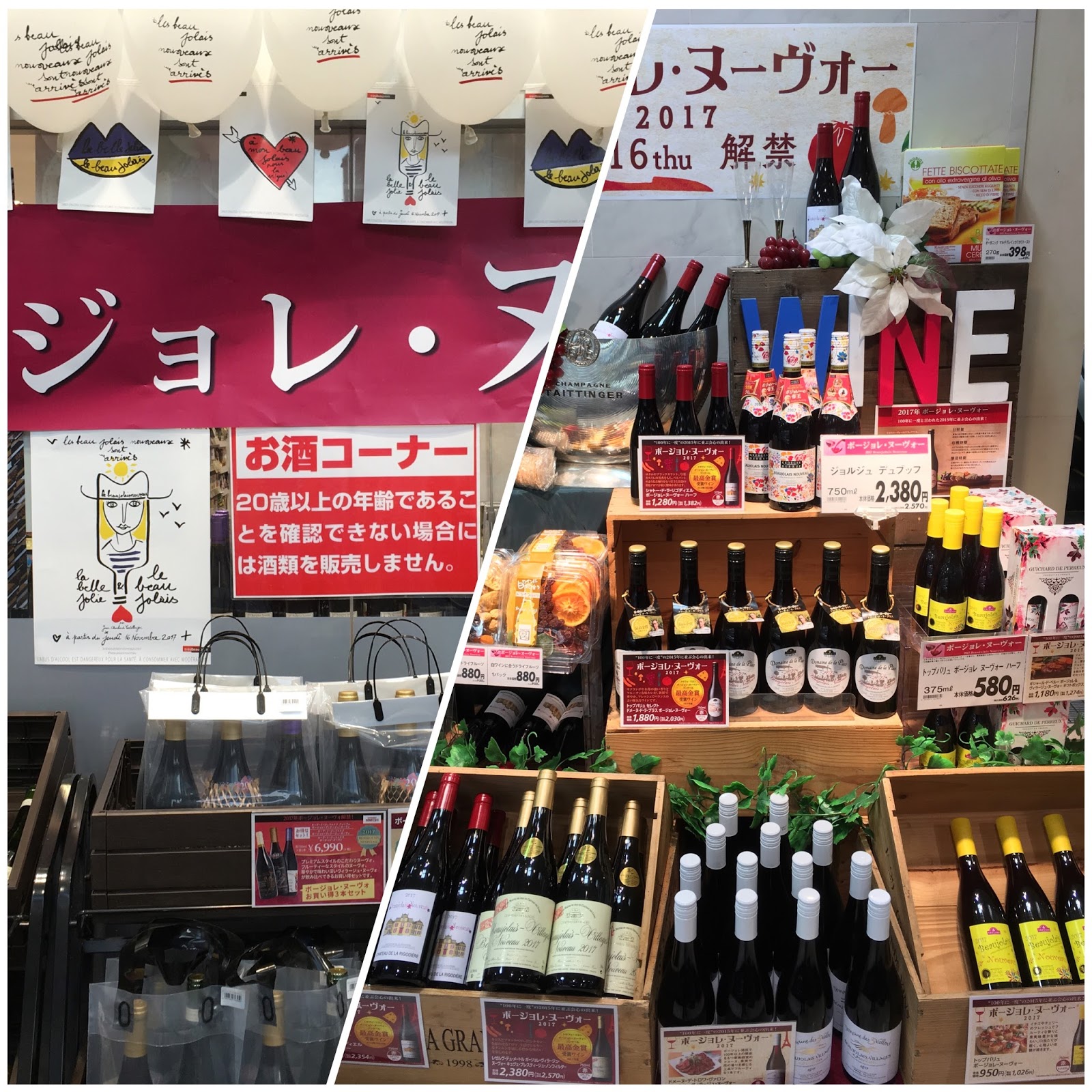
Around this time of the year - the third Thursday in November to be precise - Japan goes mad for the new batch of Beaujolais Nouveau, with lots of promotions in supermarkets (pictured below). This year imports are expected to reach almost six million bottles, double the US figures. Just north of Omotesando I spotted an outdoor drinking spot which had specially been set up so people could start drinking at 12:01 on Friday morning. Since last year, one gimmick promoted by various onsen (hot springs) has been to pour the red stuff into the communal bath (see video here)! In recent years though, despite the best efforts of the companies and businesses concerned, Japanese have begun to lose interest in the red Gamay wine. This year looks to be the fifth consecutive year that sales and imports have fallen. The peak was in 2004. Part of the reason has ironically been the growing availability of good cheap wines which has resulted in the pricey Beaujolais Nouveau no longer being seen as particularly special - or tasty - any more.
Shōchū-haibōru or chū-hai alco-pops
So what do the Japanese drink? Well, the first thing to note is that "sake" (酒) in Japanese denotes alcohol in general - the "rice-wine" we refer to as "sake" in English is called nihon-shu (日本酒) in Japan. Although well-known in the West it is actually less popular than shōchū (焼酎), a spirit originally from Kyushu distilled from barley, sweet potatoes, or rice which is also drunk straight like nihon-shu. In particular, shōchū-haibōru (highball), better known as chū-hai - a sweet "alco-pop" type shōchū cocktail - has become very popular in recent years, especially amongst young women (confusingly categorised under "liqueur" in the pie-charts below). Nevertheless, the most popular tipple remains beer (ビール), though in recent years sales have plummeted, despite the appearance of cheaper "beer-like" drinks such as happōshu (発泡酒)(low-malt beer) and zero-malt dai-san bīru (third-category beer). The pie charts below show the shift in alcohol sales between 1989 and 2015 based on this year's National Tax Agency report (available here).
Two pie charts showing the change in consumer alcohol tastes over a 25-year period

Click to preview
The drinking age in Japan is 20 in Japan but few establishments bother asking for IDs. In fact, people in their twenties drink very little in Japan; however, alcohol consumption jumps dramatically once Japanese reach their thirties. The drinking peak for men is in their sixties and for women in their forties; at these ages 58% of males and 25% of females are regular drinkers - meaning they drink three or more times a week. Moreover, drinking in public is widely tolerated, anything from a can of beer on the train to a jar of "one-cup" cheap sake drunk outside the convenience store. Being drunk in public is widely tolerated too, and plenty of places have nomihodai all-you-can-drink menus (usually with a two-hour time limit) not to mention all the beer vending machines. As a result, the sight of drunken office workers weaving around, falling over, and even vomiting in alleyways is not uncommon, especially on Friday and Saturday nights - as well as bonenkai (忘年会) end-of-year (literally "forget-the-year") party season. The nice thing though is the almost complete absence of violence - unlike in Britain where town-centres become something of a war-zone at pub closing time.

Wednesday, 15 November 2017

November 11th: Remembrance Day or Pocky Day?

As part of my Australian studies class, at this time of the year I introduce Remembrance Day to my Japanese students. As many people outside Japan are aware, Remembrance Day marks the anniversary of the armistice which saw the end of First World War hostilities on November 11th 1918. Each year Australians (and many others) observe one minute's silence at 11 am on this day, in memory of those who died or suffered in all wars and armed conflicts. However, when I ask my Japanese students what day November 11th is the answer is, almost always as follows: Pocky Day.

Pocky (ポッキー) is a much-loved long-selling Japanese crunchy long stick-biscuit covered in chocolate (though today there are a huge number of flavours, variations, and seasonal limited editions). It was voted the 17th most popular snack in a 2016 TV Asahi poll. The name comes from the Japanese onomatopoeic sound for something long breaking or snapping in two - pokkin. Pocky Day started in 1999 (year 11 in the Japanese calendar) with a huge advertising campaign, capitalising on the fact that all the ones (11-11-11) looked like Pocky sticks lined up together. See the 2017 commercial (CM in Japanese) here.

So, do Japanese remember and pay their respects to the war dead on a different day - or not at all? The first point to note is that there is no national equivalent to Remembrance/Armistice Day - the closest would probably be Shūsen Ki'nenbi (終戦記念日) on August 15th, the anniversary of the end of World War II (specifically Japan's surrender) but this is not a national holiday and while noted in the media and in an official ceremony is paid little attention by most Japanese (especially young people). Remembering the war is a much more local affair in Japan - such as the peace memorial ceremonies in Hiroshima and Nagasaki to commemorate the atomic bombings on August 6th and 9th respectively or Okinawa's Memorial Day (Irei no Hi =慰霊の日) on June 23rd to mark the end of fighting in Okinawa. The latter, held at Okinawa Peace Memorial Park, is marked by a silent prayer for the victims at noon and is a prefectural holiday. 
On a national level, paying respects to the war dead is not a simple matter: some people pay their respects at Yasukuni Shrine (靖国神社) - pictured above - where almost two and a half million souls are enshrined. However, because this includes 14 class-A war criminals this is highly controversial. Perhaps the only viable alternative is Chidorigafuchi National Cemetery (Senbotsusha-Boen=戦没者墓苑) which contains the remains of over 350,000 unidentified war dead. However, it is not widely known: most Japanese are probably more likely to be able to name the various Pocky flavours than know that Japan does actually have a national cemetery.

Friday, 10 November 2017

The Queen of Fruits - La France (Western Pear)

At the risk of getting overly fruity - the last post was about the persimmon, "the divine fruit" - I'd like to introduce a second autumn fruit, this time the "La France" (ラ・フランス) pear known as the "Queen of fruits"! Called Claude Blanchet outside of Japan after the man who discovered it, it is actually much less common in its native France where the climate makes it difficult to grow. In contrast, after being introduced in 1903 by the Ministry of Agriculture it has become the best known variety of Western pear in Japan, albeit something of a luxury item due to its high price. The pear does not fully ripen on the tree and further ripens and softens after harvesting so knowing when to eat can be a bit tricky. In order to know when it's ready to eat (tabe-goro =食べ頃) you have to squeeze it gently about a third of the way down and if it gives a little it's ready (don't do this in a shop though!).
Japanese pears (nashi) on sale
In terms of appearance it looks very different to the Japanese pear (nashi =梨) which is round like an apple (see picture). The external appearance of La France is not actually very attractive and like most Japanese fruits (yes, even including grapes!) is peeled before eating. As for taste, it has a very soft extremely juicy "melt-in-your-mouth" texture and a rich aroma. The flyer on top of the box (pictured) describes this aroma in Japanese as roman no kaori (ロマンの香り) in which kaori means "aroma" and roman means...well, actually nobody seems to know what it means! Something luxurious and exotic in the vein of "romantic fragrance" maybe?

Around 80% of La France are grown in Yamagata Prefecture, which is famous for a variety of other fruits too, including cherries and apples. Personally speaking I have a real fondness for Yamagata since that is the place I first lived in Japan when I arrived with hardly a word of Japanese back in 1992. It is also the place where I did the fieldwork for my PhD on international marriage (kokusai kekkon =国際結婚). The other day I was clearing through some old papers and found the original job posting (pictured), for a small English conversation school (eikaiwa gakkō =英会話学校), which I had first spotted in the careers office of my UK university. Apparently it's still going - the first step in a long journey!

Tuesday, 7 November 2017

The Divine Fruit of Autumn - Kaki (Persimmon)

Food in Japan seems far more seasonal than in the UK and Japanese people certainly have firmer ideas of what food is associated with what season - as reflected in the use of kigo (季語) or "season words" in Japanese poetry such as haiku. One of these kigo is persimmon (kaki =柿) - also called the "divine fruit" - a fruit with a thick orange skin and a unique taste and texture, sweet and fibrous (and packed full of vitamins). Although most closely associated with autumn, the buds, leaves, and flowers of the persimmon tree are also used as spring and summer kigo.

There are two types of persimmon: the short fat sweet type known as fuyū-gaki and the taller pepper-shaped astringent (shibui =渋い) persimmon known as hashiya-gaki. In the case of the former, persimmon lovers seem to be split between those who like to eat them hard and crunchy, like an apple, and those who prefer them soft - if you wait long enough, the (by now very sweet) fruit can be scooped out and eaten with a spoon! At the bottom of the page is a video showing how to peel a fuyū-gaki and prepare it for eating.


In Japan a common sight at this time of year are strings of peeled hashiya-gaki hanging out to dry in the sun, which, after a month or so has passed (and daily massages apparently!),  become what are known as hoshi-gaki =干し柿 (semi-dried kaki) - the verb hosu (干す) means to air or dry out. Hoshi-gaki, which are shrivelled up, flat, and covered in white sugar powder, are very sweet and often eaten as a snack or even as dessert during winter. Another very popular snack (pictured) are called "kaki no tane" (persimmon seeds), small crunchy long bean-shaped mini rice-crackers (senbei) that actually have no relation to kaki at all!

Wednesday, 1 November 2017

100 Posts - Thank-you!

Since the first post on March 7th I have now reached 100 posts with over 8000 views from more countries than I can count. Thank-you everyone, especially my Japanese audience who, continue to make up the biggest group; however, I must also give a special mention to the Russian readers who make up the third biggest source (see table below). Amazing! In terms of posts, those which include a personal element seem to be the best received - the most popular by a long way was the post about Japanese identity and my own sense of Japaneseness, written in the context of Ishiguro's Nobel Prize for literature. However, things are not always predictable: the post on manga bad-boy Crayon Shin-chan is the second most popular - go figure! Now if only I could tell which post was most popular in which country - that would be interesting. As I said in the 50th post, the blog is a labour of love, a learning experience with the added fun of opening up the stats page to see which country is top for the week and what post is popular. Feedback, suggestions, and ideas are always welcome - use the message box on the right to tell me where you want the blog to go from here: it's in your hands!

         TOP SEVEN BLOG POSTS (views)
  1. Nobel Prize Winner Kazuo Ishiguro: Japanese or not Japanese? (231)
  2. Crayon Shin-Chan: The Bad Boy of Japanese Manga (166)
  3. Fireworks, Deceased Spirits, and Teruteru-bōzu (114)
  4. Rain, Snails, and Japanese Animal Names (84)
  5.  The "Japanese is difficult" myth (75)
  6.  Wagyu, Matsuzaka Beef, and Kobe Beef: What's the Difference? (71)
  7.  The New Sex-Crime Revisions and Chikan (66)
    3月7日の最初のポストから、100ポストを突破して、数えきれないぐらいの国から8000件以上ビューをいただきました。誠にありがとうございます!相変わらず日本のビューアが圧倒的に多いですが、意外にロシアが3位になって、驚きました!国のトップ・テンが上の表にリストアップされています。人気が出やすいポストは、個人的な話が入っているものが多かったようです。ダントツで一位のポストは、カズオ・イシグロのノーベル文学賞受賞に関連して日本人のアイデンティティと自分の「日本らしさ」について論じたポストでした。しかし、どのポストに人気が出るかは必ずしも予想できるわけではありません。例えば、人気ポストのリスト(上)から分かる通り、クレヨンしんちゃんのポストが2位になってしまいました!どんな国の人がどんなポストを見ているか分かれば、ますますおもしろくなりますね。50回投稿記念の時も書きましたが、このブログは「好きでする仕事」(Labour of love)で、日常で見落としているものに気づいたり、学んだりすることが目的です。これからこのブログをどう成長させればいいか、どのような方向にもっていけばいいかは、皆さんからの提案やリクエスト次第です。是非、右側にあるメッセージ・ボックスを使用して、知らせてください!これからもどうぞよろしくお願いします!

    Thursday, 26 October 2017

    Confronting the Label "Gaikokujin": Japanese Multiculturalism as an Oxymoron

    A few weeks ago I was asked to speak at a meeting of FEW (For Empowering Women in Japan), a Tokyo-based non-profit business and social networking organisation whose mission is to “enable internationally-minded women in Japan to achieve their full professional and personal potential.” The topic was Japanese multiculturalism and the speakers (pictured) made up quite an eclectic group: there was an international coordinator from the Peace Boat, a New-Zealand writer/cross-cultural trainer, and a Japanese project manager from CLAIR (Council of Local Authorities for International Relations), a national government affiliated agency aimed at supporting the multicultural efforts of local governments. Two things came out of the meeting: (1) the national government is doing next to nothing to support foreign residents (in tandem with its non-existent immigration policy) and (2) there is a lack of knowledge and understanding about what multiculturalism and/or globalisation actually means in Japan which is illustrated by the difficulties many Japanese have dealing with non-Japanese as equals rather than exotic visitors.

    I have written at length elsewhere, both in English and Japanese, about Japanese-style multiculturalism (known as tabunka kyōsei =多文化共生) so here I will just pick up one key point from the meeting: the use of the category/label gaikokujin (foreigner).  This term forms a pair with nihonjin (Japanese): the gaikokujin vs nihonjin fixed binary is fundamental to maintaining and reinforcing difference in Japan. As I mentioned in a previous post, Japanese identity is exclusive and tightly defined - anyone who is not legally, racially, and culturally Japanese is often considered non-Japanese - that is a gaikokujin (and this can even include so-called hāfu, those with one Japanese and one non-Japanese parent). Because Japan, in principle, doesn't accept migrants or use the word migrant (imin), all "newcomers" (another nifty katakana label) to Japan are forever gaikokujin - whether they have been here a few days or many years.

    The key take-home message for me was the need to confront Japanese who use gaikokujin without thinking and who also (unconsciously) engage in various other exclusionary behaviour - sometimes termed "micro-aggressions." One panelist said she always confronts the (rather common and unpleasant) abbreviated form gaijin - literally "outside person" - as well as challenging "special" treatment in situations such as Japanese business meetings, where, in contrast to the other participants, she is sometimes referred to by her first name or without the honorific san after her name. This got me thinking how inappropriate it was to refer to someone who has been in Japan twenty-five years by the same label as someone who has been visiting for twenty-five days. So the next time someone calls me gaikokujin I'm going to reject the label and instead say I am a migrant (imin). Actually, I would prefer to claim the nihonjin label for my own but not having Japanese nationality - something I would grab immediately if Japan recognised dual nationality - weakens my case. Either way, I suspect the recipient will be completely non-plussed: nevertheless, the FEW meeting made me realise how important confrontation can be in raising awareness of how Japan needs to change if it really wants to open up and enjoy true multiculturalism.

    Saturday, 21 October 2017

    In Harmony with Nature? Gloomy Nihonbashi and the Construction State

    The zero milestone plaque (Nihon Kokudo Genpyo) at Nihonbashi
    All roads lead to Nihonbashi
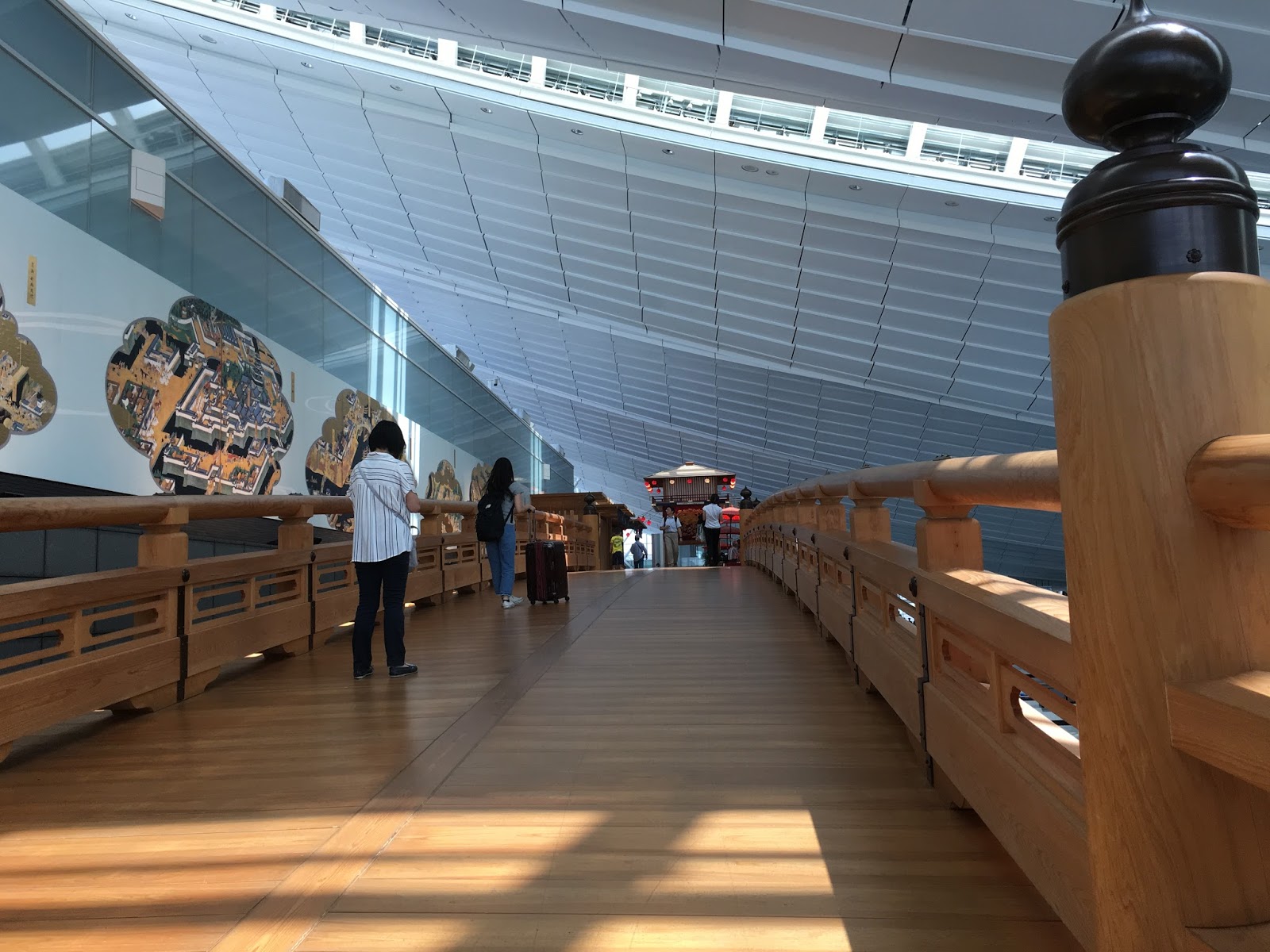
    Nihonbashi (日本橋 literally "Japan Bridge") is both the name of a bridge and also a specific business district (as well as home to the original Tsukiji fish market) located right in the heart of Tokyo. Indeed, distances to Tokyo are calculated from the bridge - see the zero milestone plaque pictured right known in Japanese as Nihon Kokudō Genpyō (日本国道元標). Today the bridge is designated an important cultural property (jūyō-bunkazai =重要文化財). The original wooden bridge dates back to 1603 but was replaced by a larger stone bridge (with a steel frame) in 1911. A full size replica of the original wooden bridge can be enjoyed at the Edo-Tokyo Museum. Unfortunately the museum is now closed for renovation until the end of March 2018, though don't despair - you can also walk over (and under) a rather lovely half-scale replica of the bridge at Haneda Airport (pictured below).
    At both the airport and the museum, the roof may detract from the illusion of walking across a real bridge but the actual bridge itself is not much better - it is dark and gloomy with sunlight (and views of Mount Fuji) blocked by a massive highway running right over the top of the bridge (pictured below)! The highway was built in the rush to get ready for the 1964 Tokyo Olympics and very much reflects the priority put on infrastructure over environment during the sixties and seventies, the years of Japan's rapid economic development (kōdo keizai seichō  =高度経済成長). 

    click to preview
    Fortunately, moves are afoot to undo the damage, with the national and metropolitan governments recently agreeing to move the highway underground after the Tokyo Olympics. Nevertheless, contrary to stereotypes of Japanese being "in harmony with nature," much of Japan is like this, as epitomised by the unsightly yet ubiquitous utility polls and wires running above ground and the presence of concrete all over the coasts and countryside. Alex Kerr's Dogs and Demons: Tales from the Dark Side of Japan (right) starts with a chapter on Japan's "construction state" and the author argues that Japan "has become arguably the world's ugliest country."

    Wednesday, 18 October 2017

    Japanese Politics in Flux (Part 2): Hoping for a Viable Opposition

    On September 25th, Tokyo Governor Yuriko Koike sent shock waves through the political establishment - and totally dominated the media - by announcing the formation of a new political party, Kibō no Tō (希望の党) or "Party of Hope" in English. Triggered by Abe's decision to hold a snap election slated for October 22nd, her announcement completely overshadowed the Prime Minister's moves to secure a political mandate for his pet-project of constitutional reform. It also prompted the main (but already disintegrating) opposition party - the Democratic Party - to effectively abolish itself, with its leader announcing that it would not field candidates in the upcoming election; members were urged to run as candidates for the new party instead. Koike made clear though that she would select only "suitable" candidates for her new conservative party - what the media has dubbed a "Death Note" playing on the popular Japanese manga of the same name. Before being given the chop by Koike, a number of centre-left members from the defunct Democratic Party formed a new party on October 2nd, the CDP or Constitutional Party of Japan (Rikken Minshutō=立憲民主党). The party is fielding 78 candidates for the election, far less than the 235 put forward by the Party of Hope. 
    Election board with four election posters stuck on
    Election poster in Kodaira, showing only 4 candidates (LDP, JCP, CDP, and "The Party of Hope"
     Considering Koike's landslide victory in the Tokyo Metropolitan elections in July, some commentators initially saw her as a genuine threat to the ruling LDP. The "hope" was that at long last Japan could have a viable opposition. Indeed, the slogan for the new party is "Hope for Japan" (Nihon ni Kibō =日本に希望) together with "citizens' first" and "a reset for Japan." On the other hand, many observers remain sceptical whether Koike can take on the dual roles of regional governor and leader of a national political party. Moreover, there has been little time to organise candidates and put together a manifesto before the election. Indeed, in my own constituency the Hope candidate doesn't  actually seem very hopeful or experienced: her poster (right) focuses on her experience as a victim of crime. After all the hype, I get the feeling that Abe will win with a slightly reduced majority and it will be back to one-party politics as usual.

    [UPDATE] Final results saw the LDP retain their two-thirds super-majority with 313 seats, down five seats - as predicted above!]

    Saturday, 14 October 2017

    Japanese Politics in Flux (Part 1): The Communist Party as the Conscience of the Nation

    Walking around the neighbourhood it is common to see political parties' posters (left) stuck to the walls of local houses, even during non-election times. With campaigning now under way for the October 22nd general election, such posters have become even more visible. Some of the most noticeable posters are from the JCP or Japanese Communist Party (Kyōsantō=共産党), the most successful non-ruling Communist Party in the world. Indeed, in recent years it has enjoyed something of a resurgence, with a sharp increase in young members  in particular. For example, in a 2015 article entitled "Red Revival", the Economist described how the party had become the strongest political opposition at the local level; a 2016 Japan Times article described the party as "riding high" as it became the second-largest opposition party in the Diet. In the upcoming election only the ruling LDP boasts more candidates. Its power stems from a solid grassroots support base and a remarkably high and steady income (see graph).
    Changes in Income of Major Political Parties (2008-2013)

    Soviet-art style JCP "Protect Article 9" poster
    Recently, the Abe administration has come under heavy fire thanks to various scandals centering on the abuse of power together with accusations of arrogance and high-handedness; July's Tokyo Assembly Election results marked a historic defeat for the LDP. The Communist Party has emerged as the only viable opposition, mostly due to the fact that it actually stands for something: it steadfastly sticks to its opposition to the security treaty between Japan and the US (AMPO) and its support for the pacifist Article 9 in Japan's constitution (see poster right). This also makes it unelectable, of course, but it revels in its under-dog role in checking excessive government power. Peter Berton in The Japanese Communist Party: Permanent Opposition but Moral Compass calls it "the conscience of the nation."

    What of the other opposition parties? The Socialist Party (now Social Democratic Party), which was previously the largest opposition party, fell apart after entering government in the mid-1990s and being forced to renounce its core principle of opposition to AMPO/Article 9 (like the JCP); the DPJ=Democratic Party of Japan (later just Democratic Party) became the main opposition thereafter but lost any credibility after a disastrous period of government from 2009 to 2012 (it finally imploded altogether a few weeks ago). In sum, the fact that today in Japan there is no opposition that could viably form a government is rather worrying and raises serious questions about the nature of democracy in the country. Of course, this may all change with Tokyo Governor Koike's recently announced new party - the subject of the next post.