Showing posts with label nature. Show all posts

Monday, 29 June 2026

Japan's Turn to the Right: The Sudden Rise of Anti-Foreigner Populism

Temperatures remain in the mid-twenties here in Japan as the rainy season continues, in contrast to soaring temperatures in London and Paris. For the Japanese, rainy season means gorgeous blue, lilac, and pink hydrangeas (ajisai) blooming everywhere, hardly surprising given that they are a plant that needs a lot of water - hydrangea itself comes from the Greek for "water vessel" - and that thrives in the high humidity and wet soil: apparently, the abundant rainfall prevents them from wilting while intensifying the vividness of their colours. Hydrangea festivals are everywhere: see here for a round-up of ten stunning spots for hydrangea viewing around Tokyo.

Sanseito election ad (Yomiuri 2025)
The end of the rainy season roughly coincides with the end of the ordinary Diet (parliament) session, which will wind up on July 17 this year. Consequenty, the damp weather matches a period of intense late-session parliamentary manoeuvering, budget approvals, and negotiations over major legislation. Japanese politics has changed a lot since the upper house election last July, an election which marked the emergence of an anti-foreigner populism previously absent in Japanese politics. As I mentioned in my final blog post of last year, the rapid rise of Japan's far-right Sanseito Party marked a frightening xenophobic shift in tone in discussions on migration and "foreigners" in Japan. My paper discussing the reasons for the dramatic emergence of a party which many have likened to Reform UK and Germany's AfD is at last out, so at the risk of alienating casual readers I'm going to summarise the key reasons for this seismic shift in Japanese politics. For those masochistic enough to want to read in full the paper check HERE!

Post on X by Kamiya (@jinkamiya) 2025/09/20

Sanseito (参政党) - literally "political participation party" - was founded in 2020 by Sohei Kamiya and others but came to prominence when it secured 14 seats in the House of Councilors election in July 2025 running on a "Japanese First" slogan (shown in the election ad above). Their key stance was opposition to current policies of accepting "too many foreigners" (行き過ぎた外国人受け入れ政策に反対) - explained in the social media post right. The election marked the first time a clearly far-right party had secured more than 10% of the national vote. The question I wrestle with in my paper is why anti-foreigner populism - something previously consigned to fringe groups in Japan and relegated to the periphery - suddenly exploded into the mainstream and why the "foreigner problem" (外国人問題) has now become a significant political issue for voters. 

My answer in a nutshell is not a right-wing political vacuum or economic hardship but a rapid increase in the visibility of "foreigners" - both residents and tourists - creating a threat perception in terms of the loss of their homogeneous identity. The COVID-19 pandemic laid the ground work in terms of upsetting the balance between intergroup contact (which tends to lead to a reduction in prejudice towards migrants) and perceived threat (which can foster anti-immigrant attitudes). And the arrival of "the age of populism" and the "first year of SNS elections" in 2024 - that is, an elite loss of control over the migrant narrative - created a fertile environment for Sanseito to exploit anxieties over rapidly growing numbers of "foreigners." In sum, a visible and rapid increase in "foreigners" has created a feeling that traditional Japanese identity is being challenged or threatened. The result has been a broad and unprecedented shift or change in tone, attitude, and policy towards foreigners, as evidenced by stricter regulations and hardening public opinion. For someone who has lived in Japan for forty years it is heart-breaking to witness the abrupt change of tone in a country in which I have always felt welcome and valued. Thoughts? Drop me a note in the COMMENTS.

Saturday, 31 August 2024

The Month of Death: Living Perfect Days in Japan in August

August is a month of death in Japan both remembered and real. Real not only because of the searing temperatures that lead to heat stroke but also because of the typhoons that sweep through the archipelago this time of year. Earlier in the month, Typhoon Ampil (No. 7) passed along the east coast of Japan causing many train and plane cancellations and disrupting the Bon holiday's return travel rush. And as I write, Typhoon Shanshan is causing devastation down in Kyushu. On top of that, a magnitude 7 earthquake struck off Miyazaki Prefecture on August 8th, triggering the first ever official week-long "megaquake" advisory as fears grew that this was the precursor of the long-expected super quake in the Nankai Trough (南海トラフ). Amid these natural disasters, the man-made disasters of Hiroshima (August 6th) and Nagasaki (August 9th) were commemorated, followed by a solemn ceremony on August 15th marking 79 years since Emperor Hirohito announced Japan's surrender (known as Shūsen-kinenbi or "memorial day for the end of the war" =終戦記念日).

The traditional Obon (お盆)holiday itself is rooted in death. Running August 13th to 16th this year, it is one of the three major holidays in Japan. Whereas some Japanese take the opportunity to travel abroad, many travel back to their hometown (furusato =古里・故郷) to honour their ancestors who are said to return to their earthly homes for a brief visit during this period. To guide the spirits of these ancestors, one often sees lanterns hung in front of houses - the pictures show scenes from my local lantern festival (灯りまつり) - as well as cucumber "horses" (shōryōuma =精霊馬)and aubergine/eggplant "oxen" (shōryōushi =精霊牛). The former are said to guide the dead back quickly while the latter, being more slow-moving, take their time helping them return to the underworld (lanterns are also floated in rivers at the end of Obon for the same purpose).

In sum, August in Japan is a time to contemplate life and death. Here, I'm going to introduce a film I watched recently which made me think a lot about how and why we live: Perfect Days (パーフェクト・デイズ) directed by Wim Wenders and starring the famous Japanese actor Koji Yakusho (who won best actor at Cannes for his performance as Hirayama). Billed as "a work of fiction with the feel of a documentary," the movie follows the daily life of Hirayama who cleans public toilets in Shibuya, Tokyo. All the toilets featured in the movie are drawn from the 17 toilets created by famous architects, creators, and designers known collectively as the Tokyo Toilet Project. The Project unashamedly promotes toilets "as a symbol of Japan's world-renowned hospitality (omotenashi) culture" and the focus is very much on accessibility, comfort, and safety. For example, this is the thinking behind the two "transparent" toilets (which turn opaque when locked): the technology allows people to easily check cleanliness and whether anyone is inside, two of the things people tend to worry about when entering a public toilet. Check out this BBC video for a more detailed overview of the Tokyo Toilet Project and visit the sites in the film (not only toilets!) using the interactive map here.

L to R: Nabeshima Shoto Park toilets, (the transparent) Yoyogi Fukumachi Mini Park toilets, and Yoyogi Hachiman toilets

Getting back to the film, Hirayama leads a very simple life with a fixed daily routine that sees very little interaction with others. He is a humble man who carries out his job diligently and with dedication, taking pride in his work. Interestingly, surveys constantly show diligence (kinben=勤勉)as the trait Japanese see as most typical of their national character (graph here in Japanese - click on #1). There is so much to take from Hirayama: the importance of noticing things around you, the value of connecting with nature, the importance of appreciating the current moment, the merits of small things and daily rituals, and the peace brought by speaking less and reflecting more. There is a gentle optimism, a tranquility about Hirayama, his life, and his philosophy that kept reminding me of mindfulness, with its emphasis on slowing down, analogue over digital, simplifying life, paying attention to the here and now, taking in your surroundings one thought at a time, and the cultivation of curiosity, wonder, and awe.

Jaz walking in the komorebi
Interestingly, the film was originally slated to be called Komorebi (木漏れ日). At the end of the film - after the credits - this Japanese word is translated as "the shimmering of light and shadows that is created by leaves swaying in the wind which exists only once, at that moment." In the film, this concept comes into its own during Hirayama's lunch break, which he takes every day at Yoyogi Hachimangu (代々木八幡宮) Shrine, a hidden oasis of calm in the middle of Tokyo. Hirayama always has simple white bread convenience store sandwiches and milk for lunch and takes a single picture every day on his disposable camera, trying to capture the perfect komerebi amongst the towering trees. Check out the video below of me trying to capture Haruyama's experience - sandwiches and all! COMMENTS are, as always, most welcome - let me hear your take on the film (if you've seen it) or indeed on any of the themes raised in the post.

Sunday, 26 May 2024

Skywalking in Ginza: Towards a New Greener, People-centric Tokyo

It's warming up rapidly here in Japan and the humidity is already stifling - I dread to think what the summer holds for us (last summer, as I've mentioned before, was the hottest on record). Even, Golden Week - a series of four public holidays over a seven-day period from April 29th to May 6th was unusually hot. Many Japanese see Golden Week as a chance to take an extended break, some jetting off to Hawaii or other foreign destinations, others just enjoying domestic tourism. Needless to say, it's crowded and expensive everywhere during Golden Week, so BritishProf usually stays home, but I did venture out to explore the Ginza skyline after getting tickets for a special event called the "Ginza Sky Walk 2024".

Ginza (銀座), made up of the characters for "silver" and "place," (following the establishment of a silver-coin mint in 1612) is famous for being one of the most pricey, elegant, and luxurious districts in the world thanks to its many upscale shops and restaurants (it has the highest concentration of western stores in Tokyo). At the same time, it is deeply rooted in history, forming part of the traditional downtown (shitamachi) centre of the old Edo capital (see here and here for my two-part take on Tokyo's old town). Walking north past the department stores and designer boutiques you eventually hit Nihonbashi and here you can find the true centre of Tokyo, the bridge marking the terminus of the roads which ran between Edo and Kyoto: as I show here, the zero milestone plaque known in Japanese as Nihon Kokudō Genpyō (日本国道元標) can still be seen on the bridge and it is from this spot that distances to Tokyo are calculated. The bridge itself though is overshadowed by a massive expressway running right over the top which was built in the rush to get ready for the 1964 Tokyo Olympics and is typical of the maze of highways scarring the Tokyo skyline. Fortunately, change is afoot and the Ginza Sky Walk 2024 marks the beginning of that change.


Ginza Sky Walk 2024 (map here) was the first chance to preview a new development project known as the KK Line Regeneration Project, "a future walkable urban development that aims to connect people with the city and the environment" that may begin to open in the 2020s but won't be finished until the 2030s or even 2040s. KK Line (KK線)is an abbreviation for the Tokyo Expressway Network (東京高速道路) and the project envisages a green pedestrian/cyclist space above the streets somewhat similar to the New York High Line. The three-day event allowed 15,000 people to take the 1.8km walk from Shimbashi to Kyobashi on the car-free elevated highway.

This push to create network of pedestrian walkways and cycle paths throughout Tokyo and introduce more green and recreational spaces is welcome. Despite the stereotype of Japanese as being "in harmony with nature," Japanese city-scapes are blighted by utility poles and wires running above ground and even the countryside is covered in concrete. Indeed, Alex Kerr's Dogs and Demons: Tales from the Dark Side of Japan starts with a chapter on Japan's "construction state" and the author argues that Japan "has become arguably the world's ugliest country." Let's hope the Ginza Sky Walk marks the beginning of a face-lift for the capital, a move from a car-centric to a people-centric metropolis.

As a final aside let me introduce an upcoming comedy show in Ginza at the Hakuhinkan Theatre (銀座博品館劇場) , a 381-seat auditorium located on the 8th floor of the Hakuhinkan Toy Park, a lovely building chock full of toys, stuffed animals, games, dolls, variety goods and souvenirs. The Newspaper (ザ・ニューズペーパ)are a Japanese comedy troupe with a 35-year history who bill themselves as a ‘social satirical comedy group' (社会風刺コント集団). In a country where political comedy is almost entirely absent in the mainstream media (mostly due to the reluctance of sponsors to offend the powers that be - see here for a detailed paper), their sharp commentary on current affairs is a breath of fresh air. The show I saw had an incredible variety of comedy techniques, and included members imitating political figures, like Kishida and Trump, as well as celebrities, such as the baseball player Shohei Otani and shogi champion Shota Fujii. To my surprise, there was even a skit centred around the Japanese imperial family, something which is usually taboo here in Japan. Highly recommended! If you're feeling peckish after the show, I would recommend Ginza's  Sukiyabashi Jiro (すきやばし次郎), the only sushi restaurant ever to get three Michelin stars. Unfortunately, reservations have to be made months in advance and, as with most places in Ginza, it costs an arm and a leg. The Netflix documentary "Jiro Dreams of Sushi" (二郎は鮨の夢を見る) may be as close as you ever get! COMMENTS as always are most welcome!

Tuesday, 27 February 2024

Skiing in Zao: Snow Monsters, Japow, and Jizo Statues

The UK may be famous for its ever-changing weather - "four seasons in one day" - but the weather this past week in Japan has been similarly unpredictable. On Tuesday (Feb. 20th) we had a high of over 23℃ here in Tokyo, with people in T-shirts and plum blossoms blooming all over. Record breaking temperatures of 25℃ in Chiba made this the official first "summer day" on Honshu this year! However, Friday (23rd) saw snow and a high of only 4℃, a drop of nearly 20℃! On top of that, we have also had the first wind of spring known as haru-ichiban (春一番), a strong southerly wind marking the change from winter to spring, characterised by a warmish day followed by more cold weather. Four seasons in a week if not a day!

© Zao Onsen Tourism Association (URL here)
Speaking of snow, recently I took a trip to Zao in Yamagata, two and a half hours on the bullet train from Tokyo, to get in a bit of skiing. Yamagata is located in Tohoku (東北) or Northeast Japan and was the first place I lived in Japan way back in 1992. I fondly remember getting the bus on weekends from Yamagata-City to Zao Onsen Ski Resort (蔵王温泉スキー場), a sprawling network of 25 trails and almost 1.9km of skiable areas with the longest run at 9km (official English site here).

Ropeway information in both Japanese and English
Zao is famous for "Snow Monsters" (juhyō=樹氷), not abominable snowmen but trees glazed with ice and snow due to water droplets in the cold air blowing from Siberia freezing. Even if you don't ski, you can ride up on the ropeway and see the Snow Monsters which are particularly impressive when illuminated at night. In recent years, though, as temperatures have risen, the Snow Monsters have not been as imposing as before. Indeed, one thing I noticed overall was how much warmer it was on the mountain, nothing like the freezing temperatures, biting wind, and low visibility of previous years. 

BritishProf with Snow Monsters
Rising temperatures and less snow does not seem to have put off tourists - in fact, it seems to have encouraged them - and visitors from Australia and Taiwan were noticeable in Zao. Indeed, the foreign "invasion" of Japanese slopes has been discussed at length, with Niseko in Hokkaido - named by some as the Japanese powder snow ("Japow") capital of Japan (link) - gaining special attention. Post-pandemic, foreign visitor numbers have well and truly recovered, encouraged by the weak yen, and foreign investment in the resort looks set to expand further. The downside is an increasing strain on the local infrastructure, especially transportation, accommodation, water, and food, with labour shortages and price increases a growing problem. Fortunately, Zao is nowhere near as crowded as Niseko and over-tourism is not such a problem - indeed, skiing over the east side of the mountain there were places when I was completely alone. Bliss!

Right at the top, we can see the amazing almost 250-year-old 2.3 metre Jizo Statue (地蔵尊), just below the 1736m Mount Jizo (地蔵山) peak. While the purpose of many Jizo Statues is to protect the spirits of children who have passed away before their parents (see here), this one serves to protect travellers from unforeseen misfortunes or disasters. Compared to past winters, when I remember only the head visible this time the snow was only up to the chest, reflecting changing temperatures. In the summer, of course, the full statue is visible and the surrounding area offers many lovely hikes. Thoughts? Do please share in the COMMENTS!

Tuesday, 31 October 2023

High Skies, Sardine Clouds, Reading Week, and Margheritas: Autumn has Come!


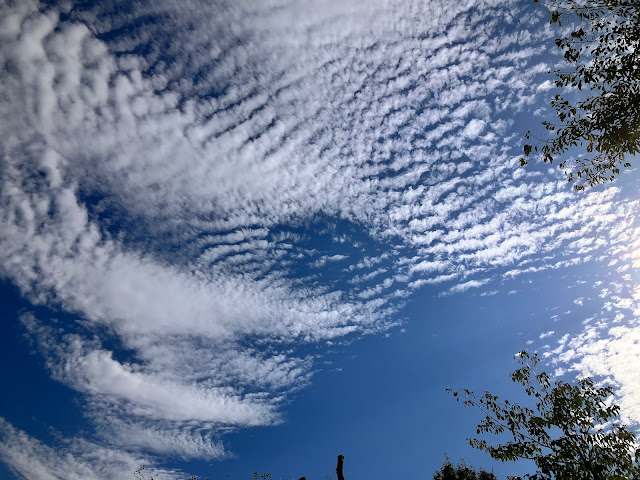
We're almost into November, but pleasant days (and short-sleeves) continue, perhaps not surprising given we had the hottest summer on record. At the same time, the sky tells us that autumn (aki=秋)has well and truly arrived. The Japanese have a lovely saying for this season, sora ga takai (空が高い) - literally, "the sky is high." Indeed, a famous (originally Chinese) proverb reads 天高馬肥秋 (ten takaku uma koyuru aki), literally "autumn, the sky is high and the horse fat" (the latter part pointing to a successful harvest). Even my weather app comments on the sky being high: the attached picture notes that, "today the clear autumn sky (akibare=秋晴れ) feels to be high." Although this expression is not found in English it is true that the sky is more blue at this time of the year, due to the humidity level dropping off leaving less moisture in the air. Cirrocumulus autumn clouds are also described as resembling fish scales (uroko-gumo=うろこ雲) - sometimes called sardine (iwashi-gumo) or mackerel (saba-gumo) clouds -  just like the English expression "mackerel sky" referring to rows of clouds displaying an "undulating, rippling pattern similar in appearance to fish scales."

©読書推進運動競技会
While season words (kigo=季語) are a staple in Japanese poetry, surprisingly clouds don't figure so much. The only one I found was this by Basho, though unusually the season is clearly identified: この秋は 何で年寄る 雲に鳥 (In this autumn/why do I get old?/ birds in clouds). Much more common are references to the moon, which in contrast to the "high" sky, often appears to sit low to the horizon, as well as being brighter, at this time of year (moon-watching or tsukimi used to be a popular group activity in autumn in Japan). Autumn in Japan is also associated with a number of other activities. One is reading, as expressed in the phrase dokusho no aki (読書の秋) and a special reading week (dokusho shūkan=読書週間) started on October 27th (though it actually runs for two weeks!). Thought to be a post-war phenomenon perhaps inspired by US Children's Book Week, others trace the phrase back to Natsume Soseki quoting an old Chinese poem about "reading by lamplight." Autumn is also promoted as a time to engage in sport and outdoor activity, probably due to the fact that schools typically hold their sports day (undō kai=運動会) during this season. Indeed, the national holiday held on the second Monday in October is called Sports Day (スポーツの日), a holiday originally established to commemorate the 1964 Tokyo Olympics. 

Nevertheless, the most common refrain one hears about autumn is the phrase shokuyoku no aki (食欲の秋) - literally autumn, the season of good appetite! While foods such as saury (sanma), matsutake mushrooms, persimmons (kaki), and pears (nashi) deserve an honorable mention, the holy trinity is probably sweet potatoes (satsuma-imo), pumpkin (kabocha), and chestnuts (kuri) - see here for a simple video on how to make aromatic chestnut rice (kuri-gohan), an autumn staple. Given the popularity of Japanese food worldwide, you might expect that Japanese people would favour eating out in Japanese restaurants but in fact Italian food is first choice for many Japanese for a nice meal out - and there are so many great options. For those of you in Tokyo, Fukuoka, or Yokohama, you have to try L'Antica Pizzeria da Michele, founded in Naples in 1870 and boasting possibly the best Margherita in Japan! And on that note, let me wish all my readers a belt-busting autumn - and do let me know in the COMMENTS what the season means to you, culinary or otherwise!

Saturday, 30 September 2023

Taking Steps to Deal with Suicide in Japan

September can be an especially stressful time for many in Japan, with school and work re-starting, and that is reflected in the fact that this and the following month are typically the worse months for suicide. This is not only in Japan of course - September 10th was World Suicide Prevention Day - but it is true that Japan, for a long time, had the highest suicide rate among the G7 countries, though it was overtaken by the US in 2017. Actually, after peaking in 2003, the rate in Japan fell dramatically in the last 15 years, including ten straight years of decline from 2009 to 2019; unfortunately, the pandemic hit many especially hard in Japan, and suicides - particularly among young women - have risen in the past three years. Below is a comparison of suicides in the UK and Japan comparing 2003 and 2022:

2003 data from WHO Global Health Observatory (here); suicide rate=number of suicides per 100,000

To raise awareness of this alarming trend, Tokoyo English Lifeline (TELL), a Tokyo-based organisation providing mental health support and counseling services to Japan’s international community, held a campaign called Move for Mental Health which consisted of a Step Up Challenge (running from September 10th to October 10th) encouraging individuals and teams to take 21,881 steps in one day, the number of Japanese who committed suicide last year, and culminating in a Tokyo Tower Climb on October 14th.

Wanting to do our bit, we got a team together and early one Saturday morning we arrived at Ome Station in Western Tokyo, planning to walk 12km to Takimoto cable car at the bottom of Mount Mitake(御岳山), a sacred mountain that has been worshipped since ancient times (the protective deity O-inu sama or Sacred Wolf attracts many dog owners too!). Ome is one of the stations along the Ome-Line in Western Tokyo which runs from urban Tachikawa to Okutama, a tiny town located in the Okutama Mountains which is actually the largest municipality in Tokyo! The route took us along the beautiful Tama River (多摩川), upstream of the Tamagawa Aqueduct which I have written about before. The line drips in nostalgia for a time gone, and indeed Ome-Station itself promotes a deliberate "Showa" vibe as the images show.

The walk along the river is truly breathtaking, white-water rapids popular with canoeists and rafters, cool clean air, incredible greenery, birdsong, families enjoying barbecues on the river bank - and even people panning for gold (video here)! But amidst the lovely scenery we also took time to remember why exactly we were walking and what each step represented. Walking along the Tama River made this all the more poignant since one of Japan's most famous writers, Osamu Dazai, committed suicide, drowning himself together with his lover in the rain swollen Tamagawa Aqueduct in 1948 just before his 39th birthday. 

The cable car at the foot of Mount Mitake - dogs welcome! - took us up to Mitakesan Station (831m), and from there was a short 1.2km climb to the summit (929m) where we found the Musashi-Mitake Shrine (武蔵御嶽神社). More interesting for me was Ubuyasu-sha (産安社) or "safe birth" shrine, a power spot featuring ancient cedar trees that when touched would bring luck in finding a partner, getting pregnant, and giving birth safely - as well as promising longevity (chōju=長寿). Given the purpose of our walk, this seemed particularly apt, and a long life is something I wish for everyone, especially those thinking of killing themselves - I pray that you can find the strength and courage to reach out to and confide in someone close to you - or to a lifeline counsellor - and take that first brave step in moving forward.

For a summary of our climb, there's a lovely video here by Diya, an English speaking therapist supporting expats, nomads, and internationals - both inside and outside Japan. For those inside Japan - whether Japanese or non-Japanese - who are struggling and need help in English, contact TELL on 03-5774-0992 or via chat (see here for hours). You are not alone. Finally, for those worried about someone but not sure what to say and do, this page has some hints, including the best way to listen and offer support, as well as how to make a safety plan together. COMMENTS are, as always, very welcome.

Tuesday, 29 November 2022

Japanese Autumn Sunsets, Falling Foliage, and Red Dragonflies

I have to apologise in advance - university entrance exams and student theses have combined to bury me in work so a short post this month! Anyway, after a cold spell a couple of weeks back, the nice autumn weather has returned. We've still rarely had to put the heating on: the sun being lower in the sky heats up the apartment in the daytime! It really is a lovely season with gloriously coloured leaves falling like confetti, spectacular sunsets (pictured), and delicious fruit: we received a box of La France pears from Yamagata last week and persimmon (kaki) the week before, known as the Queen of Fruits and the Divine Fruit of Autumn respectively.

The other morning, while standing on the balcony, a red dragonfly (tombo or, in old Japanese, akitsu) - a symbol of strength, good fortune, and happiness - landed on the railing right beside me. Whereas in England the dragonfly is often dismissed as just another insect, here in Japan it has a special place in Japanese hearts; Japanese are very fond of the critter with its large compound eyes and two pairs of beautifully latticed transparent wings and children even try to catch them using various clever techniques. As a fast predatory insect that apparently never gives up it is also known as katsumushi (winning insect) and appeared on samurai armour as a symbol of determinedness and victory. In fact, Japan itself was even once called Dragonfly Island (Akitsu-shima) because of its shape! The insect has inspired generations of poets: in haiku poetry, the dragonfly is a season keyword (kigo=季語) for autumn, capturing the essence of the season, as seen in the following stanza by Scott King: "The red dragonfly; a small amount of sunset; trapped in its wings"

As mentioned earlier, another spectacular feature of the season are the changing colour of the leaves, fondly known as kōyō (紅葉) in Japanese which includes both the red/orange Japanese maple and the yellow Ginkgo trees. Much like cherry blossom-viewing, Japanese take this very seriously and will travel for miles to visit a nice spot. One of the most popular places in Tokyo central in both spring and autumn has traditionally been the Imperial Palace grounds and a few days ago (November 26th) Inui Street was opened to the public for autumn foliage viewing through December 4th (here). I don't have time to even travel that far at the moment, but fortunately my university has some spectacular maples and other trees in magnificent shades of red, orange, and green. Almost makes it worth going into work - almost! What does autumn mean to you? Let us know in the COMMENTS!

Thank-you to David for the amazing pictures!

Friday, 23 July 2021

Back to Basics: Lilies, Lotuses, and Lanterns in Japan

Back in March 2017, this blog started as a place to share the things I see when out and about; as the header implies, it began with a strong nature focus and posts were short and frequent. Today, more than 200 posts and some 128,000 views later, the posts are much longer but less frequent (once a month); the content has also taken a much more culture and society turn than originally intended. With this in mind, I'm going "back to basics" and today am going to introduce the wonderful and extremely colourful array of flowers which I enjoyed during my daily dog walks during Japan's rainy season (yes, rain, shine, or typhoon Jaz insists we go out!).

Clockwise from top left: African Lilies (アガパンサス), Barbados Lily (白筋アマリリス), Flame Lily (グロリオサ), Madonna Lily (マドンナリリー), Orange Daylily (ワスレグサ), and Tiger Lily (オニユリ)
 

The first images are of lilies, those large trumpet-shaped colourful flowers which catch the eye at this time of year. Delightful to observe, comparing the English and Japanese names is also rather interesting. For example, the Orange Daylily is so-called because it only flowers for one day so the Japanese name wasuregusa (literally "forgotten plant") is no surprise! I noticed hundreds of tiny white aphids on the stems of these lilies (inset), aphids which eventually turned orange (like the lily) and sprouted wings. How strange!

(L to R) Indian or Sacred Lotus bud, flower, flower with stamen visible, and dried seed cup
 

Speaking of lilies, the water lily is revered in Japan (reflected in Japanophile Monet's many Water Lily and Japanese Bridge paintings). A few of my neighbours grow these amazing plants - more accurately known as Indian/Sacred Lotus or Hasu in Japanese - in large pots of water since it is obviously aquatic (the minimum water depth is about 30cm). The lotus root (renkon) - a crunchy, starchy, slightly sweet potato with holes - is a popular food in Japan, apparently making up about 1% of all vegetables consumed! One of the most beautiful sites to view these plants is Shinobazu Pond in the south of Ueno Park; in the summer, the surface of the pond is almost completely covered!

Another plant of note at this time of year is known as Asian (or Chinese) Lizard's Tail (ハンゲショウ) so called because each flower spike resembles a reptile's tail (?). This is actually a herb - in the past it has been used to treat inflammation - and can grow more than one metre high. The Japanese name Hangeshō can be written as either 半夏生 or 半化粧, the latter literally meaning "half make-up" reflecting the way the leaves appear to be painted half-white, as if someone had taken a white make-up brush to them but never finished the job. 

To finish off on a seasonal note, our final example is the Chinese Lantern (ホウズキ), also called the Devil's Lantern (鬼灯), a flowering plant with large bright red and orange airy husks covering its fruit. In the past, elementary school students would "pop" the balloon-like husks and gather the mini-tomato like fruit inside. As pictured, these lantern-like plants appear in shops in the run up to the holiday of Obon (August 13-16 this year), a key holiday when Japanese honour their ancestors who are said to briefly return to the world guided by lanterns - real or plant-based - hung in front of houses. Then, at the end of the holiday, the lanterns (or Devil's Lantern) are placed into rivers to guide their ancestors back to the underworld. A market/summer festival dedicated to the plant known as Hōzuki-ichi (ほうずき市)is held every year on July 9th and 10th near Senso Temple (浅草寺) in Asakusa.