Regular snapshots of everyday life plus musings on Japanese culture and society for Japanese language learners and Japan lovers in general. Subscribe for email notifications when a new post goes up or send me a request (on the right panel). Comments are also welcome (link below each post).
After a (chilly) time in the UK and a (scorching) time in Sicily, BritishProf is finally back in Japan to prepare for the start of the new university term. Although Southern European temperatures reached into the forties, the dry heat was surprisingly bearable compared to the high humidity here in Japan (which is still stifling). Japan had the hottest July in 125 years (here) and though we're almost into September, there is still no respite from the fiercely hot days and tropical nights. While in the UK, I spotted a poster advertising an exhibition by 94-year-old contemporary artist Yayoi Kusama, currently partnering with Louis Vuitton. Perhaps Japan's most successful living artist, Kusama lives in a mental health facility and creates art to keep her anxiety and fear at bay. A key theme of her work is the feeling of losing the boundary between the self and the other and the motif "self-obliteration" - look out for a future post on my visit to the Kusama museum in Tokyo.
A "fureai" experience with Harry
For now, let's go a little low brow and take a look at Japan's cafe culture. While cosplay influenced maid cafes (enjoyed by both men and women) and butler cafes (mainly for women) have captured the attention of the media, even more popular are the ubiquitous animal cafes where one can enjoy a drink and snack while petting a wide variety of cute animals. While cat and dog cafes were the trailblazers, today, in Tokyo at least, there is probably a cafe for almost any kind of small animal you can imagine - capybara, snakes, lizards, owls, hedgehogs, miniature pigs, lovebirds, penguins, sloths, and ottersto name but a few. Now BritishProf is not a big fan of animals kept in captivity for the purpose of human entertainment - I have written before about Japan's lax animal welfare rules - but I was lucky enough to come across a newly opened dog cafe that trains therapy dogs for work in hospitals: a cafe called Florencein Adachi City, Tokyo.
Florence, which opened in May this year, is billed as a "first-rate healing space where you can interact with your favourite dog" (好きなワンちゃんと触れ合える極上の癒し空間). The cafe and the dogs are separated by acrylic barriers, so it is quite possible to enjoy a coffee and a snack while just watching the dogs. Most customers though will opt for the hands-on "fureai" experience: fureai (触れ合い) is a Japanese word made up of the characters for touch and join/fit/match and usually describes some sort of emotional and/or physical connection, contact, or interaction between people, animals, or even nature. A public square, for example may be called a fureai hiroba (ふれあい広場). Close in meaning to the unique Japanese term "skinship" (スキンシップ), one survey found that during the pandemic over 40% of Japanese suffered from a lack of "heart-to-heart contact" (kokoro no fureai=心のふれあい), affecting their mental well-being. Even now, with more and more people engaging in telework, using social media, and living in single-person households, opportunities for face-to-face contact and communication seem less than before, to the extent that Japanese - particularly Japanese men - have been described as the loneliest, most isolated in the world (PDF here). In this context, a visit to this kind of space where one can interact with dogs of all sizes and also their handlers/trainers is truly miso soup for the soul. Why not share some of your own fureai tips in the COMMENTS?
I recently had the opportunity to meet someone from the Finnish Embassy to talk about Japan's immigration policy (or lack of); afterwards, the conversation turned to the current sauna boom in Japan. While the first sauna in Japan is typically traced back to 1957 in a bathhouse in Ginza, it was the Finnish athletes at the 1964 Tokyo Olympics bringing sauna equipment that triggered the first sauna boom here. During the 1970s and 1980s saunas combined with public baths and massage parlours to create a second boom, though the sauna remained something of an old guy thing. Today, though, young people of both sexes are enjoying saunas - taking sauna trips (satabi), enjoying special food (sameshi), and basking in totonou (整う): the refreshed, euphoric feeling when you jump between a sauna and a cold bath (see herefor a nice graphic in Japanese). Sauna related manga have also exploded - indeed, "Sado" (way of the sauna), a six-set manga series which started in 2016, is said to have sparked the current third boom.
Glamping in the gorgeous Nasu wilds - but watch out for bears!
One possibly unique feature of saunas in Japan is the use of tent saunas which can be set up wherever you like. And talking of tents, there is another boom going on at the moment in Japan: glamping or glamorous camping! As regular readers will know, the Japanese summer is scorching which makes an air-conditioned tent the perfect (guilty) summer pleasure. We visited Hamiru's Forest Glamping Resort and Terrace in Nasu, a small town in Tochigi, northeast of Tokyo, famous for its beautiful hot springs, mountains, forests, rivers, and hiking trails - no wonder the Imperial Villa, where the emperor stays in August and September, is located here!
Panoramic shot inside the tent - complete with hammock, aircon, and fridge!
The resort was rather wonderful, 21 dome shaped tents, each with a separate hut for barbecuing, a dog run, a camp fire area (with marshmallows and sticks for purchase), and a shared shower/bath which could be booked for your preferred time slot. As well as hiking trails and hot springs, there are loads of small cafes and shops selling ice-cream, cheese, and various dairy-themed snacks (like "Butter's Cousin"=バターのいとこ). In short, Nasu is the perfect destination for an urban de-tox!
There was one more attraction that the Brit in me couldn't resist, the Penny Lane Beatles cafe/restaurant/shop set in a beautiful English-style brick building with comfortable leather armchairs and sofas and crammed full of Beatles memorabilia, such as photos, posters, guitars, classic albums, and original drawings - all with a Beatles soundtrack in the background of course. This book argues that the Beatles 1966 tour to Japan was something of a turning point in Japan’s postwar cultural development, marking the start of a deepening relationship with the West and even contributed to the construction of a new Japanese identity! Whether you believe that or not, the cafe is highly recommended; in fact, while we were there, there was a nice reminder of our rural location when a wild monkey raided the cafe only to be chased off with a staff member brandishing a cap gun! Maybe a reference to The Beatles song nobody knows, "Everybody's Got Something to Hide Except Me and my Monkey"?? Whether you're a Beatles, sauna, or glamping fan, do please drop me a COMMENT!
Rainy season in Japan (covered hereand herein previous posts) began in earnest on June 8th in Tokyo. While tsuyu (梅雨)has a number of downsides - such as high humidity, mouldy futons, and washing that never dries - there is also one big upside: the flowering of beautiful hydrangeas(ajisai)! As the pictures below show, the deep, varied colours and intricate petals are really something.
Visiting indoor museums and exhibitions is one popular activity during these damp, sticky weeks, and Tokyo has a new attraction on offer: June 16th saw the opening of Warner Bros. Studio Tour Tokyo - The Making of Harry Potter, only the second park of its kind after the original location in the UK, and touted as Asia's first world-class Studio Tour. Located in the northwestern edge of Tokyo, the studio is built on the site of the old Toshimaen amusement park, and the area has fully embraced the change, with flags all over Nerima-Ward and a refurbished Toshimaen Station with trains featuring the main characters.
How popular is Harry Potter in Japan? Extremely I would say, with Japan ranked as the third best area for Harry Potter fandom (after the UK and US). The stats back that up: apparently, the films have grossed more than US$893m and been seen
by more than 78 million people here, while the Philosopher’s Stone remains the
country’s sixth highest-grossing film of all time. On top of that, there is the Wizarding World of Harry Potter which comprises a whole section of the Universal Studios Theme Park in Osaka. And don't forget the famous Harry Potter cafe in Akasaka! In terms of content, the studio itself is identical to the UK one (I should know - I've been there twice!), with the addition of a full-scale Ministry of Magic set (replete with floo-network fireplaces!) unique to Japan. The only downside is the pricing: while the tickets themselves are not too bad (¥6,300/£35 for adults), souvenirs and snacks are shockingly expensive. The food hall, for example, boasts a selection of food "with a British twist" which made me embarrassed to be British, including a microscopic all day breakfast for ¥2,200/£12 and the saddest looking roast beef and Yorkshire pudding you'll ever see for ¥3,200/£17.50 (pictures here). And don't get me started on the Hedwig cake for ¥1500/£8 and the sludge pretending to be butter beer at ¥1,100/£6 a pop.
But this is Harry Potter, and even corporate greed cannot sully the charm and magic of the story - indeed the magic has become reality in the form of Quidditch (a fictional sport from the Harry Potter world which is now played for real!). In Japan, the sport boasts a diverse and inclusive community, and there are now eight Quidditch (now called Quadball) teams. Moreover, the Japan Quadball Association (JQA) selected national team (nicknamed "Japan Broomstars”) is currently preparing for the 5th IQA World Cup in Richmond, Virginia on July 15th and 16th. One of the team, an American working in a small town in Mie Prefecture, was recently the subject of a short segment on NHK news. Unfortunately, Japanese players going to the US, many who are students, have to fund themselves so a crowd-funding site opened up on June 12th - if you can spare a few Galleons do please support the "Broom Stars Japan" here (unfortuntely Japanese only). And as always, let me know what you think in the COMMENTS!
The Japan team uniform (left) features a comet, which is hōkiboshi in Japanese - literally broom star!
The start of May featured the Golden Week holiday - a series of consecutive holidays giving Japanese the rare chance to take a block of time off to travel or return to one's hometown - and the weather was absolutely gorgeous! Many Japanese enjoy cycling and hiking during Golden Week - the picture shows a stunning view of Mount Fuji from Oyama, Kanagawa, a sacred mountain not too far from Tokyo billed as one of the great spots to hike in eastern Japan. Resting at home afterwards - I like to put a hammock out on the balcony - there is one sound during the months of March to October that personifies the Japanese summer, perhaps even more then the buzzing cicadas - the crack of bat hitting ball. Indeed, a key and eagerly watched event of the summer is the National
High School Baseball Championships (Natsu Koshien=甲子園) the largest scale amateur sport event in Japan which culminates in a two-week final tournament in August.
As a Brit I'm pretty clueless about baseball - I didn't even realise there was a UK team until recently - but I did attend one game in Japan (in Fukuoka) and was quite taken aback by all the organised chanting and dancing. There was also a mass release of rocket ballons at some point in the game - and beer sellers wandering around with giant kegs on their back! My American friends tell me that Japanese baseball actually differs from the
US version, with a smaller ball, playing field, and
strike zone plus a twelve or fifteen inning limit in which draws are allowed - though that doesn't mean a whole lot to this baseball ignorant Brit to be honest! Although a relatively new sport, it has become a part of the Japanese psyche and is pretty much the unofficial national pastime in terms of popularity. It was introduced in 1872 by an American and the professional league was establised in 1936; today there are two leagues of six teams. The picture shows the monument of the birth of baseball in Japan at Gakushi Kaikan, Tokyo.
While baseball remains the most popular sport both to watch live or on TV (see here), in terms of participation the number of people in Japan playing soccer (7.5m) recently edged above the baseball playing population (7.3m). This may change following "Samurai" Japan's recent victory in the World Baseball Classic (WBC) in March which saw Japan become world number one with a dramatic 3-2 victory over America in the final. In Japan, this game recorded 42.4% household viewership rating (視聴率), astonishing given that the game started at 8am on Wednesday here! The quarter-final between Japan and Italy was actually the highest-rated game in WBC history at an incredible 48.7%, meaning the game was watched by almost half the population. The Baseball Hall of Fame and Museum (野球殿堂博物館) at Tokyo Dome is currently holding a special exhibition to mark Japan's triumph and soccer-loving BritishProf went to check it out. The sacrifices one makes as a blog writer!
The museum is rather small but packed full of mementos of previous WBC games, including signed baseballs, winner's medals, and Ohtani's jersey from this year's victory (pictured). Unfortunately, the actual trophy was doing the rounds of Japan's baseball grounds when I visited. There is also a lot of information on the birth and development of baseball in Japan and of course a huge room featuring all those who have been elevated to the hall of fame (including quite a number of non-Japanese).
And so back to the hammock - and the hypnotising thump of bat on ball and cheers of the crowd carrying on the wind. It's incredible I can hear the chants and songs from so far away; below is a video clip from a National High School Baseball Championship game showing just how frenzied a Japanese baseball crowd can get! In the meantime, if there are any sports lovers among you, especially baseball enthusiasts, do please drop me a note in the COMMENTS! (Used under Creative Commons Attribution license. Credit to @chibasportsouendan, direct video link here.)
Japan does not generally feature much in the UK media, and if it does the focus is typically on something exotic or wacky, but recently the UK papers have been full of articles on "Sushi Terrorism" following online videos of customers at conveyor belt (kaiten) sushi chains engaging in various unhygienic behaviour such as licking communal soy sauce bottles. While labelling it "terrorism" seems a bit of a stretch - the Japanese media generally used the word itazura meaning mischievous, naughty, or engaging in practical jokes - the behaviour did cause shockwaves in a country which prides itself on cleanliness and also loves its fish. On that note, I thought I'd focus this month's post on the subject of seafood.
What fish are eaten in Japan and UK? Brits tend to be rather conservative when it comes to fish, and 80% of all seafood eaten in the UK is one of the "Big five": cod, salmon, haddock, tuna, and prawns. On the other hand, the most popular fish in Japan were salmon (sake/shake), tuna (maguro), pacific saury (sanma), mackerel (saba), and yellowtail (buri). As hinted at before, Japanese eat a broader variety of fish - there is a strong awarness of what fish are currently in season - and eat it at different times of day too, prepared in different ways (grilled salmon at breakfast for example). 84.3% of Japanese say they eat fish at least once a week, with only 1.9% saying they do not eat seafood at all. In contrast, only a third of Brits eat fish weekly, with 12% saying they never eat it - with the younger generation even less likely to eat fish. Who said Fish and Chips was the national dish?!?
For tourists looking to get a taste of a Japanese fish market, the typical destination is Tsukiji (see also my blog post here), though this (partly) relocated to Toyosu in 2018, including the famous early morning tuna auction (you can view this from the observation deck - if you're lucky enough to get a ticket through the lottery system!). However, if you want a more tourist-free local spot - and a chance to see a real live fish market without any ticket lottery - I'd recommend Numazu Port, located at the northwestern end of the Izu Peninsula (about an hour's drive from Atami covered in last month's blog!). Numazu is full of restaurants offering kaisendon (海鮮丼) or fish bowl, various kinds of raw fish (sashimi) piled on a bed of rice - a mountain of DHA delight!
Aside from fish there are a number of other interesting things to see and do in Numazu, not least great views of Mount Fuji on clear days. At the top of Numazu Port Observatory Watergate (沼津港大型展望水門), which also functions as an anti-tsunami barrier, there is a great observation deck and I was lucky enough to catch some good views of Fuji-san, which show the snow beginning to melt. The guide in the tower also allowed me to use a picture she had taken in November on a particularly clear day - thank-you! There is a also a rather interesting statue in the park, a memorial to Chiune and Yukiko Sugihara who issued visas to save Polish Jews fleeing from the Nazi's in 1940. It has been estimatedthat around 100,000 people are alive today as a consequence of Chiune's actions.
Two views of Mount Fuji (March left and November right) taken from the observation deck at Numazu
Click to see on amazon
Finally, let me introduce my favourite snack - eel bones! Loyal blog followers may already know that eel or unagi is one of my favourite dishes: as I wrote here, unagi is a stamina-boosting food that is a particularly popular way to beat summer heat fatigue. Whereas the bones on unagi are always removed before serving in restaurants, the bones themselves can be deep-fried and flavoured (typically with soy sauce, wasabi, or just salt) and make a super moreish crunchy snack, one that is full of calcium and vitamins A, B2, D, and E! Definitely recommended, especially as tsumami (side-dish) with beer or sake or as a heathy oyatsu (snack) for children. If you can't get hold of eel bones where you are, then you'll just have to make do with salivating over the all-you-can-eat sashimi restaurant"Osakana [fish] Paradise" captured in the video below. Enjoy - and do let me know about your fish eating habits, preferences, and recommendations in the COMMENTS!
Temperatures are rising and it feels like spring has come at last - with Tokyo cherry blossoms officially reaching full bloom on the 22nd, change is definitely in the air. Speaking of change, on the 13th, Japan belatedly eased its long-standing recommendation to wear a mask and is now officiallyleaving it up to personal choice (kojin handan=個人判断). Nevertheless, most people are still taking a wait-and-see approach and continue to wear masks while checking out what others are doing - a nice illustration of how peer pressure still rules in Japanese society.
The seasonal and social change makes it a good time to travel, and I took the chance to visit the popular tourist spot of Atamion the Izu Peninsula, a seaside (and, in the past, honeymoon) resort less than an hour west of Tokyo on the bullet train. Atami (熱海)literally means "hot sea" which refers to the famous onsen hot-spring baths dotted in the many ryokan (traditional Japanese inns) in the surrounding volcanic hills. Living up to its name, the weary traveller is greeted with a public hot spring footbath (ashiyu=足湯) on leaving the station, somewhat oddly named the "Ieyasu Hot Water Footbath" to mark 400 years since Tokugawa Ieyasu - first shōgun and one of the great unifiers of Japan - visited Atami.
Truth be told, there's not actually much to see or do in Atami apart from soak in the hot springs and eat seafood - in fact, Atami is now more of a commuter hub for Tokyo than a tourist spot. However, we did take a trip to tiny Hatsushima Island (see video from the 30-minute ferry ride below) which ironically has a lot more to do! There is one notable monument in Atami though, located by a pine tree overlooking the artificial beach, and that is a statue of a man, wearing traditional wooden geta sandals, kicking a Japanese woman on the ground, who is holding her arm up in self-defence.
Apparently, the statue depicts a scene, set on Atami Sun Beach, from a serialized novel called Konjiki Yasha (The Golden Demon=金色夜叉) written by Koyo Ozaki, a leading literary figure of the Meiji Era. The novel's themes are the loss of humanity, social responsibility, and love in the face of money. The scene depicts a "climatic farewell", in which the heroine, O-Miya, has just revealed to her lover, the student Kan'ichi, that she has accepted a proposal of marriage from a rich banker's son, swayed by the gift of a diamond ring. No doubt aware of the problematic nature of the image, the plaque justifies it as follows: "The statue, which depicts the most symbolic scene full of love and sorrow of the two who have grown apart, faithfully reflects the original story. In no way does it condone or promote acts of violence. We would be very pleased if you could read through the novel and consider the pair's emotions, as well as the social conditions of the time." Nevertheless, in these days of statues being torn down, and after a pandemic which saw domestic violence consultations reach record levels and female suicide spike in Japan, one can only wonder about the kind of message that such a statue sends to all those visiting this "honeymoon" resort. Do put your thoughts on this and recommendations for your favourite travel spots in the COMMENTSplease!
We've had some pretty cold days and even some snow - unusual for Tokyo - since I last wrote, and temperatures are very much up and down at the moment. News-wise there's been a lot of sympathy for the victims of the earthquake in Turkey and Syria, due both to Japan's own experience (the March 2011 Tohoku quake was the strongest in Japan's recorded history and the 4th biggest worldwide) and its close historical affinity with Turkey. Last month, the high court ruled that the Tokyo Electric Power (TEPCO) executives could not have predicted the massive tsunami that led to the Fukushima nuclear facility meltdown, even though a 2002 government report had actually estimated even higher waves. Government scientists tend to be very accurate with their numbers; the latest calculations give a 70% chance of a mega quake hitting Tokyo before 2050.
Speaking of calculations, Japanese have long come near the top in mathematics in international rankings (PISA rankings here). For those wondering why countries like Japan, Korea, and China perform so well in maths, you need look no further than the humble abacus, called soroban (そろばん)in Japanese. Walking through the neighbourhood the other day, I spotted a sign board outside a house advertising soroban tutoring. The key sales pitch was the way abacus-style mental arithmetic (anzan=暗算, literally "dark calculation") promotes brain development and mental agility by stimulating both left (language) and right (visual) sides of the brain. Indeed, those proficient in the soroban become able to complete mental arithmetic remarkably quickly in the their head by visualising an imaginary abacus. There are even "flash" mental arithmetic competitions in which competitors instantly add, subtract, multiply, or divide numbers of 1 to 3 digits that flash on a screen (video here- check out the speed of the guy around the one minute mark!). It is no surprise that in the mental calculation world championship - held every two years in Germany - Japan has consistently featured in the top three. And these guys are fast: a famous contest between a Japanese soroban user and an American calculator user in 1946 resulted in the abacus scoring a "decisive victory" and beating the machine in both speed and accuracy in everything but multiplication.
Derived from the Chinese suanpan, the soroban has been used in Japanese schools for some 500 years, though with the spread of electronic calculators it is no longer a compulsory subject (it still remains common in elementary schools as a way to visualise and grasp basic mathematical concepts). As the picture shows, the modern soroban - which interestingly is the same as the roman abacus - has four "earth" beads below the "reckoning bar" (these are the "ones") and one "heavenly" bead above (the "fives"). Moving a bead towards the bar turns it "on", allowing each rod to represent a number from 0-9. The numbers of rods varies from 13 and 17 to 23 or even 27 (longer soroban enable more complicated calculations incorporating several different numbers at the same time). Below is a video of my wife, who was trained to use the soroban in a bank to confirm the day's transactions, adding the numbers from 1 to 10 (totaling 55) and then adding two 4-digit numbers. If you want to try it out yourself, no need to buy one: there are loads of drill books as well as various apps which allow you to practice on a phone or tablet (check outsoroboard=そろボード in Japanese and Soroban Training in English - there is also a wonderful video of kids using sorotouch=そろタッチ here). A great way to keep the brain active - let me know what you think in the COMMENTS!
Akemashite omedetō gozaimasu (明けましておめでとうございます) - Happy New year - to my readers from a very chilly Japan! We're going through a once-in-a-decade cold spell as I speak, so now may be a good time to take those New Year Decorations - which typically start coming down on January 7th - to the local shrine to be burned before a big bonfire. This is known as dondo-yaki (どんど焼き), a practice that supposedly "releases" the gods which the decorations have been housing over the new year period. Another common new year decoration, the ubiquitous kagami-mochi (twoglutinous rice-cakes stacked on top of each other) are traditionally opened and eaten on January 11th in what is known as kagami-biraki (鏡開き). As you can see from the picture, these are typically topped with a tangerine, referred to
as a daidai which is actually the colour orange in native Japanese
(the repetition of the syllables supposedly points to the
continuation of generations over the changing years).
As I explained in an earlier post, the name kagami-mochi comes from its shape: the copper mirrors or kagami used in the Muromachi period were round like a mochi. The kagami-mochi is thus two round lumps of rice cake (mochi)
with the smaller one placed on top of the bigger one (representing the
past year and the year to come). Kagami-biraki - literally "opening (breaking open) the mirror" - festivals are held all over Japan around January 11th, with the most famous being the annual New Year event held at the Nippon Budokan hall in Chiyoda-ku, Tokyo. Here kagami-biraki involves donning Samurai armour (yoroi), the ritualistic breaking of large mochi offering (as featured on the poster), and taking to the battlefield. It also includes a ceremonial sake toast (sankon no gi) which is no surprise since kagami-biraki also refers to the traditional breaking of a sake casket at weddings.
While most people buy their New Year mochi decorations ready-made from the supermarket (made of plastic with a small rice-cake inside), some people do still make mochi themselves in a process which
requires the glutinous rice to be strenuously kneaded. Traditionally,
this is done in a wooden or stone mortar (usu) with a heavy wooden mallet in a process known as mochitsuki which is often carried out as a community or neighbourhood event. Pounding the mochi two
hundred or so times gives it a smooth, shiny and whiter appearance. More importantly, it is soft enough to eat, though being rather bland itself it is usually consumed with toppings like natto (fermented soy beans), walnut paste, roasted soy-bean flour (kinako), and/or soy sauce (pictured).
Koshōgatsu (Little New Year) on January 15th - a nod to the old lunar calendar - bookends the New Year period, and usually marks the last day for disposing of decorations. Although many Japanese are unfamiliar with Koshōgatsu, some rural communities still pray for a good harvest and eat azuki-bean rice porridge (小豆粥) on this day. One of the most disturbing Koshōgatsu traditions was that of hitting newly-wed brides on the backside with a sacred wooden pole or broom to ensure their fertility, a practice known variously as yome(no shiri)tataki (嫁[の尻]たたき) or yome-iwai (嫁祝い), literally "hitting the daughter-in-law's bottom" or "celebrating the daughter-in-law." Thankfully, this pretty awful "tradition" was banned in the post-war period, though a modern, ostensibly pain-free, version involving children gently "stroking" the newly-wed's bottom with small brooms is still going (see here). In contrast, one tradition that remains largely unchanged, at least in Niigata, is muko-nage (婿投げ) or "son-in-law throwing" in which a newly-wed groom is thrown down a snowy slope in the general direction of his new wife (see here). Not sure if that does much for fertility but with the plummeting birthrate, I suppose anything is worth a try. And on that note, let me ask you what your favourite (unorthodox) Japanese traditions or festivals are - answers in the COMMENTSplease!
Local temple with pair of kadomatsu New Year decorations out front
The year is drawing to close, and Japanese people are typically wishing each other all the best for the coming year using the phrase yoi otoshi o (よいお年を). Post-Christmas, people have been hanging New Year decorations (such as that pictured) on their doors and pairs of pine and bamboo kadomatsudecorations are often placed either side of gates and entrances. While pandemic-wise things are slowly returning to normal in Japan - masks remain practically obligatory though outside the home - other events have made this a tough year for many, not least financially as many families struggle with rising food and utility prices. With this in mind, I thought I would focus on something we definitely need more of in this topsy-turvy world - love.
Earlier in the year, I had the chance to spend time in Osaka for a conference and
visited a couple of spots which suggest that Japan's second city - OK by
population actually third - is actually the best place in Japan for
romance. This may seem a stretch to those that live there: Osaka is
undoubtedly a friendly place with great foodand entertainment, and (astonishingly) came in 2nd place in the 2021 Global Liveability Index, but even locals would hesitate to call it a love hot-spot. So let me introduce two places that persuaded me otherwise.
The first is the Umeda Sky Building (梅田スカイビル) located in the north part of the city, a short walk from both Osaka and Umeda Stations. While not particularly tall, it is the architecture that makes it stand out, two separate buildings connected on the 40th floor with a circular "floating garden" observation deck (Kūchū Teien Observatory=空中庭園展望台) and joined with two aerial escalators that seem to hang in the air (don't look down!). Umeda Sky Building was actually chosen as one of the top 20 buildings around the world in a 2008 article in The Times (PDF here). In terms of romance, the sparkling cityscape itself is mesmerising and at night is packed with couples; you can even buy a heart-shaped padlock, engrave your names, and fix it to the "Fence of Vows" where it will apparently stay forever!
The second reason for nominating Osaka as the city of love is the delightful Tsuyu no Tenjinja (露の天神社) Shrine popularly called Ohatsu Tenjin (お初天神). The popular name refers to the geisha Ohatsu who apparently committed a double suicide with her lover Tokubei at the shrine in 1703, a story which was popularised in the bunraku puppet play The Love Suicides of Sonezaki (曾根崎心中). The play was so popular that it sparked a spate of love suicides and was eventually banned by the bakufu; today, however, the shrine has become a "sacred place for lovers" (恋人の聖地) where couples visit to pray for eternal love and also where singles can pray for romance to come their way. Heart-shaped ema (絵馬), small wooden plaques on which wishes are written, are hung up all over the shrine, which also features manga-style and stone life-size images of Ohatsu and Tokubei, fortune papers (omikuji) tied to giant hearts, a tunnel decorated with wind-chimes, and a large multi-coloured frog (?). Check out the video below and see if you can spot all these things - and perhaps add a COMMENTabout your favourite shrine or temple in Japan. In the meantime, it only remains for me to wish you yoi o toshi o and pray that 2023 brings you - and people all over the world - lots of love!
I have to apologise in advance - university entrance exams and student theses have combined to bury me in work so a short post this month! Anyway, after a cold spell a couple of weeks back, the nice autumn weather has returned. We've still rarely had to put the heating on: the sun being lower in the sky heats up the apartment in the daytime! It really is a lovely season with gloriously coloured leaves falling like confetti, spectacular sunsets (pictured), and delicious fruit: we received a box of La France pears from Yamagata last week and persimmon(kaki) the week before, known as the Queen of Fruits and the Divine Fruit of Autumn respectively.
The other morning, while standing on the balcony, a red dragonfly (tombo or, in old Japanese, akitsu) - a symbol of strength, good fortune, and happiness - landed on the railing right beside me. Whereas in England the dragonfly is often dismissed as just another insect, here in Japan it has a special place in Japanese hearts; Japanese are very fond of the critter with its large compound eyes and two pairs of beautifully latticed transparent wings and children even try to catch them using various clever techniques. As a fast predatory insect that apparently never gives up it is also known as katsumushi (winning insect) and appeared on samurai armour as a symbol of determinedness and victory. In fact, Japan itself was even once called Dragonfly Island (Akitsu-shima) because of its shape! The insect has inspired generations of poets: in haiku poetry, the dragonfly is a season keyword (kigo=季語) for autumn, capturing the essence of the season, as seen in the following stanza by Scott King: "The red dragonfly; a small amount of sunset; trapped in its wings"
As mentioned earlier, another spectacular feature of the season are the changing colour of the leaves, fondly known as kōyō (紅葉) in Japanese which includes both the red/orange Japanese mapleand the yellow Ginkgotrees. Much like cherry blossom-viewing, Japanese take this very seriously and will travel for miles to visit a nice spot. One of the most popular places in Tokyo central in both spring and autumn has traditionally been the Imperial Palace grounds and a few days ago (November 26th) Inui Street was opened to the public for autumn foliage viewing through December 4th (here). I don't have time to even travel that far at the moment, but fortunately my university has some spectacular maples and other trees in magnificent shades of red, orange, and green. Almost makes it worth going into work - almost! What does autumn mean to you? Let us know in the COMMENTS!
This week temperatures have suddenly plummeted to something like mid-November to early December levels and the pleasant autumn weather I wrote about in the last post has turned unseasonably chilly, though the skies remain royally blue. The leaves too are beginning to change colour, what the Japanese call kōyō (紅葉). In Yokohama Chinatown - which I mention at the end of this post - Chinese lanterns are being set up shaped like dragons and mystical phoenix-like "fenghuang" birds to celebrate the Chinese new year from Tuesday through to February (see here). 2022 is most definitely edging towards its end.
View of Yokohama Bay from Yamashita Park, with Osanbashi Hall on the right and the sail-shaped Intercontinental Yokohama Grand Hotel in the background, just beyond the famous red-brick warehouses (covered in the previous post)
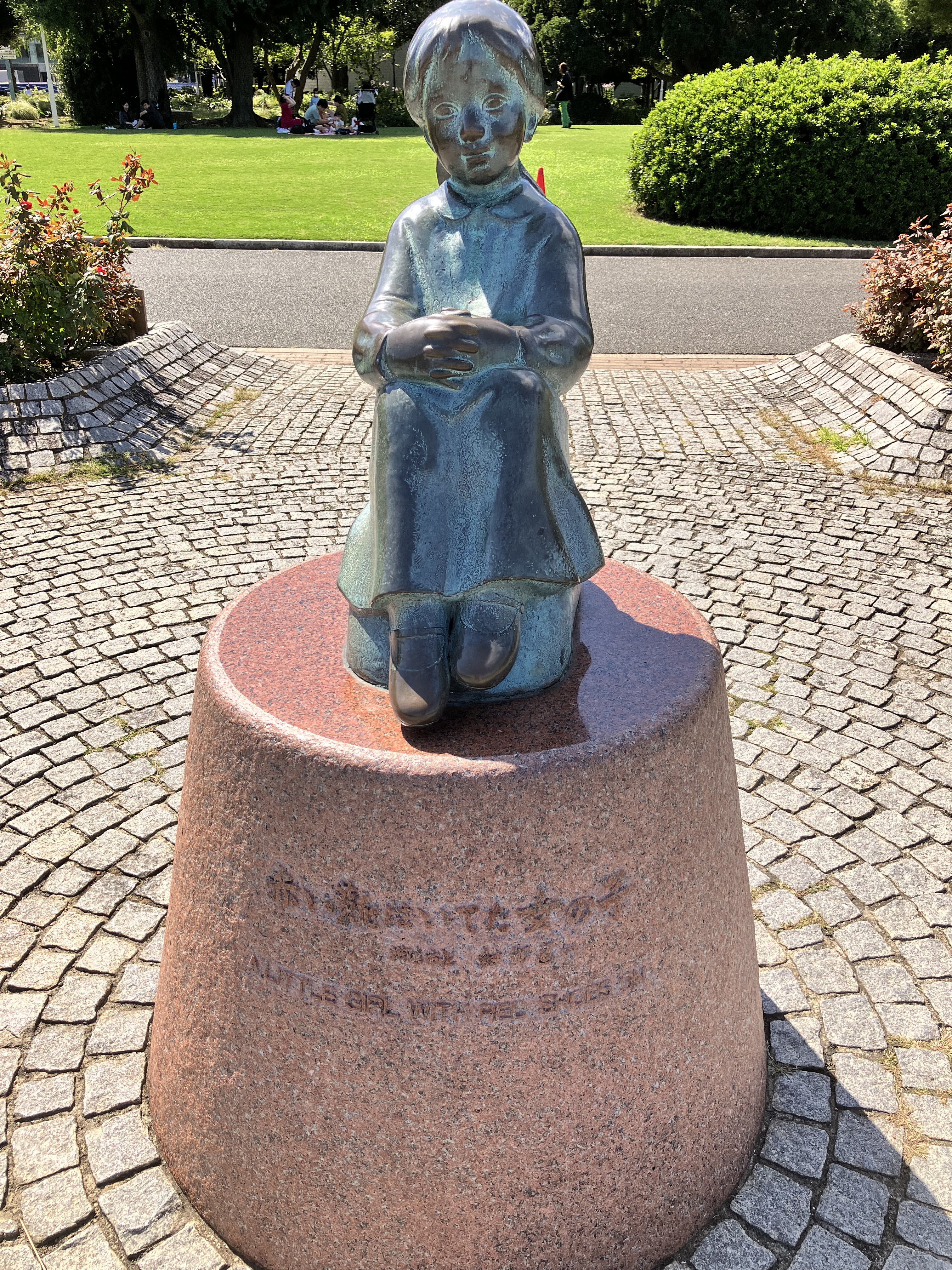
One of the things I like about living in abroad is the way it fosters a sense of curiosity about your surroundings, an inquisitiveness about things around you that often disappears in your home country when you grow up. Interestingly, curiosity is the foundation of mindfulness: observing, being non-judgemental, and, most importantly, slowing down. Perhaps living in a foreign country is good for your mental health?!? A good example of Japan piquing my curiosity came during my recent trip to Yokohama when, walking towards Yamashita Park, I noticed images of red shoes on the pavement slabs. Arriving at the park, I then discovered a statue called "The Girl with Red Shoes". What on earth was this all about?
The base of the statue reads "A Little Girl with Red Shoes on" (赤い靴はいてた女の子) and the shoes themselves shine after being rubbed (for luck?) by countless numbers of passers-by. Next to the statue are the words to a children's nursery rhyme, set in the Port of Yokohama, which it says was first performed in 1921:
A Young Girl Wearing Red Shoes was taken away by a foreigner (ijin=異人)
She rode on a ship from Yokohama Port, taken away by the foreigner
I suppose her eyes have now turned blue living in that foreigner's country
Every time I see red shoes, I think of her; everytime I encounter (au=逢う)a foreigner, I think of her
This is all rather disturbing as it seems to depict a young girl being kidnapped by a foreigner! The word ijin, literally "different person", was used up to the end of the Meiji Period to describe those from outside Japan. Further digging reveals it may have been based on a (partially) true story, the story of a girl, Kimi, whose parents asked an American missionary to adopt her and take her to America but who actually died of tuberculosis in an orphanage before she could go. However, others argue that most of the story is a fabrication and that the poem/song was in fact a metaphor for the demise of socialism in Japan (see herefor a rather lengthy discussion). This got me thinking about the symbolism of red shoes: as a child of the 80's my first thought was of David Bowie's "Let's Dance" which uses red shoes as a symbol of western civilization and colonial control. Indeed, Louis XIV was said to have used fashion - the wearing of red heels - as a form of social control, the colour representing absolute power. Then again there is Hans Christian Andersen's 1845 fairytale "The Red Shoes" about temptation. But I digress. The point is that small observations can trigger an exciting chain of thought!
This post was supposed to be about Yokohama's Chinatown, the 160-year-old 500㎡ district crowded with some 250 Chinese restaurants and shops, including second-hand clothes shops and kitchen stores, but it looks like I've run out of time and space! Needless to say, it's definitely somewhere you should visit, if only for the incredible food; right now, Taiwanese fried chicken and Beijing-style candied strawberries seem to be the big thing. As I mentioned last time, this year China and Japan are celebrating 50 years since the start of diplomatic relations in 1972 and given the poor state of relations it was encouraging to see both Japanese and Chinese flags being waved together during the recent October 1st celebrations to mark the National Day of China. Check out the lion and dragon dances in the video below and, as always, don't forget to add a COMMENTif anything in this month's blog has piqued your interest!
Autumn approaches and temperatures vary wildly here in Japan. A couple of weeks ago a cool front made things decidedly chilly, but this weekend has been a perfect 29℃, with a nice autumn breeze and none of the horrible summer humidity. This unseasonal heat doesn't match the calendar: today (October 1st) is traditionally called koromo-gae, the day for changing your wardrobe from summer to winter clothing! Typhoons have hit almost weekly recently, bringing torrential rains and much damage down south. It is the season of crickets (suzumushi) chirping quietly (replacing the intense buzz of the summer cicadas) and also the period when the stunning Red Spider Lily (higanbana) blooms briefly. The change in the season is also reflected in the food available - Japanese are much more conscious about seasonal foods than the British - and the supermarket is full of autumn staples: matsutake mushrooms, chestnuts (kuri), Pacific saury (sanma =秋刀魚 - the fish name itself contains the kanji for autumn!), sweet potato, pumpkin, and persimmons (kaki), the "divine fruit" of autumn.
In the university at least, autumn is also the season of non-stop work, known evocatively as jitensha-sōgyō (自転車操業), literally "bicycle operations" based on the analogy that if one stops pedaling (working) even for a minute you'll fall off! But on the other hand, it is a beautiful season to be out and about and a little rest is definitely needed so at the risk of falling irrevocably behind on the work I took a short one-night break in Yokohama. Yokohama is Japan's second largest city - bigger than Osaka - and is found just south of Tokyo, on Tokyo Bay. The cosmopolitan port city is a tourist mecca, an economic, cultural, and high-tech industrial hub famousfor its Chinatown, museums, (amusement) parks, and shopping. The most visible landmark is undoubtedly the Cosmo Clock 21 100m high Ferris wheel in Yokohama Cosmoworld which even boasts two transparent "see-through" gondolas (and a view of Mount Fuji if you're lucky!). The night-time illuminations are not to be missed!
We decided to try out the Intercontinental Yokohama Grand, located on a pier and famous for its spectacular views over the bay. The hotel itself is shaped like a sleek yacht under sail (or a segment of a tangerine?) and is a short walk from Minato Mirai Station. The cosmopolitan feel and sense of history are everywhere, no surprise given that Yokohama was the first gateway to trade with the west: Commodore Perry landed here, with a fleet of warships, in 1854 to present US demands for a trade agreement, persuading the Japanese government to end its national seclusion policy and sign what were known as the "unequal treaties". Still wanting to limit contact between Japanese and Western "barbarians", the new port was built near the tiny isolated then-village of Yokohama. The original trading port was a two-pier wharf known as Zō-no-hana (elephant's trunk), named so because of its shape, and the wharf remains to this day. Later, state-of-the-art warehouses built from red brick sprang up, the red-brick (hardly ever used to construct houses in Japan) a symbol of the international nature of Yokohama. Red brick is synonymous with the "foreign"; indeed, I remember visiting an elementary school in rural Japan once and the first question I was asked was whether I lived in a red-brick house!
One of the famous red-brick warehouses (赤レンガ倉庫) with the Yokohama Landmark Tower, the 2nd tallest building in Japan, visible in the background
There's so much more to write about Yokohama, so I'm going to leave it here for now and continue next time. In particular, I'm going to focus on Chinatown, perfect timing give the two countries are now celebrating 50 years of diplomatic relations! In the meantime, why not leave a COMMENT- which would you prefer, a mountain view (Mount Fuji) or a sea view (Tokyo Bay)?


.jpg)
.jpg)