Saturday, 21 May 2022

To Die for: Japanese Tatami Straw Mats

Near the end of the latest James Bond film, No Time to Die, 007 confronts the villain in a Japanese-style room (washitsu =和室). The first thing I noticed was that Rami Mallek was sitting in traditional seiza style (kneeling while sitting on the heels), a rather uncomfortable posture common at the tea ceremony and posh restaurants that guarantees cramps and pins and needles after any length of time (this page refers to it as "the foreigner's nightmare"!). The rest of the world though seemed to focus on the tatami flooring, Japanese straw mats which it turns out were made by a small three-man shop, Morita Tatami, in Tokyo. Orders apparently poured in after the film was released. 

So what is tatami? Japanese language learners may recognise the verb tatamu (to fold) reflecting the fact that tatami was originally a thin mat that could be folded up after use. Modern tatami though is much thicker (typically 3-5cm), the standard size being a 180cm by 90cm rectangle. The base or "core" is usually rice straw or (more cheaply) woodchip/fibreboard. This is covered with rather lovely smelling rushes (specifically igusa soft/common rushes =い草)or Japanese paper. The long-sides are usually edged with brocade or cloth as in the picture. Morita Tatami has a informative page in English with a figure explaining the different choices and sizes available (sizes and thicknesses differ regionally - Okinawa, for example, has square tatami!). Many houses in Japan have at least one washitsu Japanese-style room, which is typically used for (formally) receiving guests and may also host the Butsudan (Buddhist household altar) if they have one. Note to visitors: always remove slippers when entering a tatami room!

Most neighbourhoods boast a small tatami artisan workshop, like Morita Tatami, with machines such as those in the picture for crafting tatami. They typically do a brisk trade, since tatami don't age well and fraying tatami is a very bad look (scattering small pieces of straw all over the house!). If you visit a traditional Japanese-style inn (ryokan=旅館) your room will often be a Japanese one with futons in the closet to be brought out at night when you are ready to sleep and then put away in the morning. At home, this custom is not only an excellent way to save space but also encourages you to air bedding regularly. Moreover, sleeping on firm tatami in a futon directly on the floor is much better for your back (alignment of the spine); furthermore, sleeping near the ground is cooler since you are near the airflow, especially important during the hot Japanese summer. Personally speaking, I'm now so used to sleeping on a futon that I tend to find western style mattresses much too soft! Incidentally, tatami is not limited to flooring - tatami slippers, bags, dinner mats, and other accessories are also available!

Despite Japanese-style tatami rooms becoming less common in new houses, real estate plans in Japan still give room sizes - regardless of whether the room is western or Japanese-style - in terms of tatami size! For example, the picture shows an ad for a 3LDK house, meaning 3 bedrooms (in this case one Japanese and two western-style rooms) plus an all-in-one Living Dining Kitchen space (=LDK). While it is unsurprising to see the Japanese-style room (middle-right) described as 6 (帖) meaning 6 tatami mats (roughly 10㎡), it is more surprising to see the two western-style rooms at the top also given in tatami terms ("about" 4.5 for the one on the left and "about" 6.3 for the one on the right). Even the LDK is described in such terms - in this case "about" 16.6 ! Japanese seem to find it much easier to visualise room sizes when described in such terms; indeed, when buying an air-conditioner or such, they are usually recommended for rooms of a certain . Mysteriously though, overall house size is always given in square metres, in this case a rather tiny 75.99㎡ - probably about the same size as the room Bond met his nemesis! Looking forward to hearing your thoughts in the COMMENTS section.

Friday, 29 April 2022

Getting Away from it all: 5 Days in the Yaeyama Islands, Okinawa (Part 2: Identity and Food)

In the last post, I detailed my spring trip to the Yaeyama Islands. This time I'm going to focus on the delicious edibles found in Okinawa; food posts also seem to be the most popular so I'm hoping for a few more comments this time! Previously, I hinted at the unique culture found in Okinawa but didn't really explain the historical background. Very briefly, Okinawa was an an independent kingdom before it was invaded by the Satsuma clan in 1609 and finally annexed by the Meiji State in 1879. Perhaps the nearest analogy in UK terms is Wales, a region with a separate language and culture which was annexed in 1536. Both Wales and Okinawa suffered from discrimination and assimilationist policies of the central government: Okinawans - also known as Ryūkyū or Uchinanchū - just like the Welsh, have a complex relationship with the "mainland" (hondo=本土 in Japanese) and the ethnically different Yamato people. 

Source: Welsh data from BBC Cymru Wales annual St David's Day poll 2019 (here) and Okinawan data from research by Shunsuke Tanabe 2021 (PDF here)

As the poll data above shows, while the majority of Okinawans (and Welsh) feel both Okinawan and Japanese (Welsh and British), significant numbers feel Okinawan not Japanese (Welsh not British) or more Okinawan than Japanese (more Welsh than British). A few feel just Japanese (or British). The fact that Okinawa suffered disproportionately during World War II further complicates the relationship, as did the ensuing 27 years of U.S. "occupation" (1945-1972); in fact, next month (May) marks the 50th anniversary of the return of Okinawa to Japan (though even today around 75% of US bases in Japan are in Okinawa, taking up almost 18% of the main island).

Okinawa Fair at the local 7-11 promoting goods containing Okinawan brown sugar (kokutō)
Like Wales, Okinawa has many unique foods which make travelling there a delight. Two of the most common staples are goya champurū and Okinawan soba noodles. Champurū shares the same linguistic roots as the common Japanese word champon, which means to mix different things - usually food, especially noodles (as in the famous Nagasaki dish), but also drink, as in drinking a variety of different alcoholic drinks in one night! It is no surprise then that goya champurū is a stir fry of goya ("bitter melon", a super-healthy bumpy green cucumber-like vegetable), pork, tofu, and eggs. Okinawan soba noodles on the other hand consists of thick white noodles made from wheat flour (as opposed to the usual buckwheat) and is typically served with slices of pork on top. Indeed, pork is ubiquitous in Okinawa, and as well as the delicious melt-in-your-mouth fatty pork belly (rafutē) marinated in the local awamori sake, you will also find pig's feet, ears (mimigā), and even faces on many menus - Okinawans say that every part of the pig can be eaten except for its trotters and oink!

For those with a sweet tooth, Okinawa won't disappoint either. Here, I'm going to introduce three classics (from left right in the picture): Sātāandagī (サーターアンダギー) doughnuts, Chinsukō biscuits, and Blue Seal ice-cream. First, Sātāandagī - Sātā means sugar and andagī means deep-fried in the local lingo - are basically deep-fried dough balls with a crispy outside and fluffy inside which, despite their simplicity, enjoy a cult following. Second, Chinsukō are shortbread-like biscuits with a long history which are hugely popular souvenirs. In contrast, our final sweet treat, Blue Seal ice-cream, has a much shorter history, being a post-war US military invention created to give American soldiers in Okinawa a taste of home. Restricted to bases only until 1963, they are now available everywhere; you can enjoy some  unique local flavours such as the number one seller Okinawan salt-cookies (in other words Chinsukō!), beni-imo (purple sweet potato), and shīquasā ( = flat lemon) sherbet. I also seem to remember hearing about a goya flavour at some point, but it's not listed on the company homepage - too bitter?!?

All in all, the Okinawan diet, low in sugar and high in grains, fish, and seafood, is thought to be the main reason for the islander's longevity - Okinawa ties with Sardinia as the region with the highest ratio of centenarians in the world! But while the purple sweet potatoes, goya, and tofu/soy are without doubt the key to their long life, today the move towards fattier foods has seen life expectancy plummet. One of the worst offenders is Spam, introduced by the US navy and now an integral part of the local cuisine (popular in onigiri rice balls and sometimes even replacing pork in the famous goya champurū described above). Maybe it's time for a Japanese version of the famous Monty Python sketch, though, unlike the British public, Okinawans show no signs of becoming tired with the canned pork concoction! Share your thoughts on spam and regional foods/identity in the comments below.

Sunday, 27 March 2022

Getting Away from it all: 5 Days in the Yaeyama Islands, Okinawa (Part 1: Sightseeing)

With the quasi-state of emergency (manbō) now over and new COVID cases decreasing it seemed like a good time to take a spring holiday break and recharge the batteries. While international travel still poses various challenges (not the least of which are Japan's stringent regulations for getting back in), domestic travel is picking up again and I decided to visit a place as far away from Tokyo as possible, one which I always wanted to visit: the Yaeyama Islands (八重山諸島) in Okinawa Prefecture.

The Yaeyama Islands are located some 400km from the Okinawan mainland and over 1900km from Tokyo accessible via a 4-hour flight to Ishigaki, the political centre. Despite the name ( 八, read as hachi or ya(tsu), is the kanji for eight), there are actually 12 inhabited islands in the archipelago plus a number of uninhabited islands (including the disputed Senkaku Islands as well as the most southern and most western points in Japan - Yonaguni Island is only a hundred kilometres or so from Taiwan!). 

(Map used under the under the Creative Commons licence as detailed here)

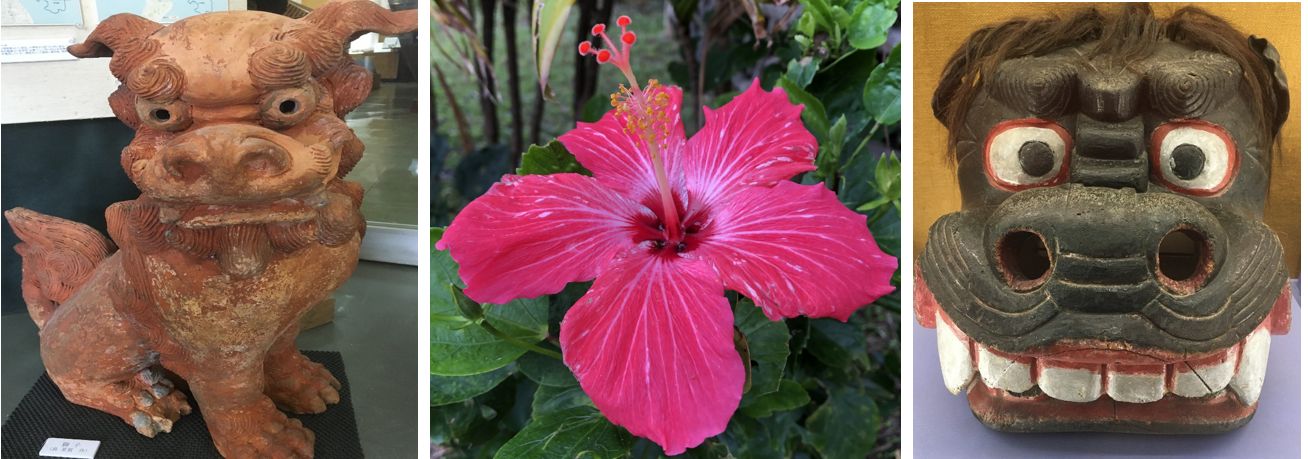
The islands are full of beautiful beaches, clear turquoise waters, mangrove forests, sugarcane fields, pineapples, and orange terracotta roofs. The tropical, almost aloha Hawaiian, vibe is supremely relaxing and the temperatures were comfortable mid-twenties (at the same time Tokyo was hit by a snow flurry resulting in a gap of 20℃ on one particular day!). Speaking of terracotta, traditional pairs of red clay guardian lion shīsā (シーサー) are everywhere, typically guarding the entrances to houses, businesses, and even bridges (covered here in a previous post). Chinese influenced lion masks also feature in local festivals revealing the strong Chinese influences underlining Ryukyuan culture. 

We stayed on Kohama, a small island 25 minutes by ferry from Ishigaki with a population of 600 - there seemed to be more goats than people - and only a single shop. The snorkeling was a particular highlight - amazing to lose yourself in a pristine underwater world of fish and coral. Kohama is also famous for the granny group KBG84 (a play on the teen idol group AKB48), evidence perhaps of the healthy Okinawan diet (the staple food on the island is the purple-fleshed yam or sweet potato - beni'imo - rather than rice). Talking of food, there is so much that is unique or different in Okinawa that I'm going to save it for part 2. In the meantime, I'd love to hear about your favourite places in Japan as well as the dream destinations you'd love to travel to. I've covered a number of spots around Japan so far - Tokyo, Hakone, Dazaifu, Shizuoka, Zushi, Enoshima, Kamakura, Karuizawa, Kyoto (part 1 and part 2), and Mount Fuji - but if you'd like me to cover somewhere else do please let me know. Click HERE to comment!

Friday, 25 February 2022

Remembering and Forgetting the War: A Visit to the old Hitachi Aircraft Electric Substation

While the UK has heralded the end of COVID restrictions, I struggle to remember what life was like before the pandemic in a Japan that shows little sign of re-opening and returning to "normal". Dwelling on the past is never a particularly healthy way of living; on the other hand, forgetting it entirely risks repeating the same mistakes. Today, I thought I'd take a serious turn and talk a little bit about Japan's complex relationship with history, as a country in the unique position of being both victimiser and victim in WWII.


In order not to get too abstract I'm going to introduce a local building damaged in WWII which was officially scheduled to be demolished but after a campaign by local citizens became a designated cultural property (文化財=bunkazai) in 1995, opening as a fully-fledged museum in 2021 after expensive repair work. Located in a Higashiyamato South Park, the building is officially titled the Electric Substation of the old Hitachi Aircraft Co. Ltd Tachikawa Factory (旧日立航空機株式会社立川工場変電所). Built in 1938, it transformed and supplied electricity to the nearby Hitachi aircraft plant but became a target for US air raids towards the end of the war. As the picture shows, the building is covered in bullet marks and damage caused by the shrapnel.

When I visited, I was lucky to meet Shigeya Narazaki, one of the official guides and also a certified English interpreter. He told me how he had visited the US National Archives to get copies of the some of the "damage assessment" pictures taken by the US Military (apparently such information is generally not publicly available in Japan). He described the three separate days of attacks: bombing and strafing by over 50 Navy Grumman F6F Hellcats, Curtiss SB2C Helldivers, and GM TBM Avengers on February 17; strafing by P51 Mustangs on April 19th; and bombing by B29 bombers on April 24th (one of the 500 pound bombs is pictured above). Among the 111 casualties were mobilised student workers (学徒勤労動員=gakuto kinrōdōin), including girls from the university I currently work at.


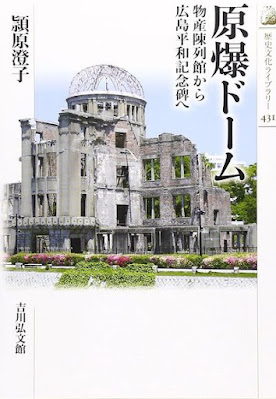
The clear message, as in many similarly preserved WWII buildings around Japan, is not to forget the horrors of war and to strive for world peace. The most famous of these building is probably the Hiroshima Peace Memorial or Atomic Bomb Dome (原爆ドーム)which was kept as a memorial to those who died in the atomic bombing (the bomb exploded directly above the dome). While the Dome was recognised as a World Heritage Site in 1996, it was not without controversy: the US abstained, expressing concern that the context behind the bombing would be lost, while China argued that it would take attention away from Japan's victims. Certainly, anyone who has seen the Dome cannot but be moved by the physical evidence before their eyes - the absolute horror of a city of civilians being nuked; but on the other hand, it can generate a sense of victim consciousness that leads to a collective amnesia as to the reasons why they became victims. In sum, if the purpose of such "relics" is truly to prevent a recurrence of war, just showing WHAT happened is not enough; it is also necessary to provide explanations, from multiple perspectives, as to WHY it happened and WHO was responsible. What do you think about preserving historical monuments for future generations? How is the history of war handled in your own country? Let us know in the COMMENTS below.


Sunday, 30 January 2022

Tempting Tempura: Typical Japanese Food?

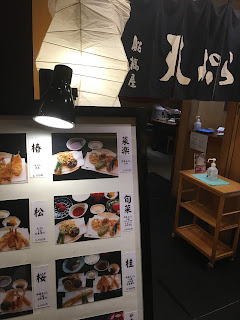
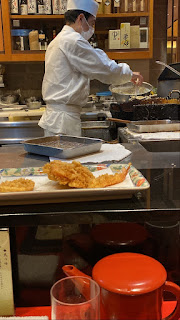
While COVID cases in the UK seem to have peaked, the situation here in Japan is getting worse by the day - Tokyo had over 17,000 cases yesterday, a massive increase from the beginning of January when there were less than a 100. As a result, we are now in the rather strangely termed "quasi/semi state of emergency" (まん延防止=man'en bōshi shortened to manbō by most Japanese) which literally means "prevention of the spread of disease." All this really signifies is that restaurants are "encouraged" to close by 9:00pm and limit the serving of alcohol (with subsidies for those that cooperate). Most do cooperate, and bring in their noren early (a noren is short curtain hung at the entrance signifying they are open - white letters on blue in the picture). Luckily, I did manage to enjoy eating out over the winter holiday and seeing as food posts always seem to be the most popular - the number one all-time post is my one on wagyu - this time I thought I'd talk a little about tempura and my visit to a tempura-ya, a specialised tempura restaurant.

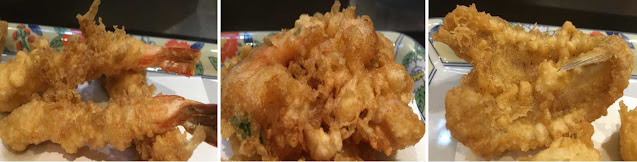
Three kinds of tempura (left  to right): shrimp, kakiage (mixed fritter), and ayu (sweetfish)

Although tempura is usually thought of as a "typical" Japanese food, the concept of deep frying in oil was actually introduced by the Portuguese in the 16th century. During the Edo Period, tempura - battered deep-fried fish and vegetables - was a popular street food, and today it is everywhere: from cheap supermarkets to high class kaiseki restaurants. 

The tempura batter must be freshly mixed using ice-cold water, flour, and egg yolks to give a fluffy, airy texture (recipe here). The ingredients are then cooked at a relatively low temperature for a short time usually in sesame oil. Once done, tempura should be eaten immediately either by dipping in tentsuyu (天つゆ), a light sauce made of dashi broth, mirin, and soy sauce (with added grated daikon radish and ginger as in the picture below) or by dipping in salt: the restaurant I went had three different types of salt, natural, herb, and moshio (藻塩), the latter a kind of traditional salt made from burning seaweed. The salt option is apparently more popular in the Kansai area - and also more popular amongst tempura connoisseurs. Watching the chef work non-stop, memorising orders, making new batter, and frying the various ingredients - eggplant, shiitake mushrooms, pumpkin, white fish, shrimp, sweet potato, lotus root - to crispy perfection was fascinating. It was also interesting to see him occasionally fishing out tenkasu (crunchy bits of fried batter floating in the oil) using an ami-jakushi (網杓子) mesh scoop.

As a final aside, I would like to note that from this year comments are open! I'm going to get the ball rolling by writing my personal opinion down and hopefully readers will follow up with theirs! So what is your favourite Japanese food - and what other foods would you like me to cover? As well as wagyu mentioned earlier, I've also covered sukiyaki, yakiniku, takoyaki, oden, curry rice, grilled eel, sushi, and gyūdon. Did I miss anything? Let me know in the comments (click on "X comments:" after "Posted by Chris Burgess at 12:29" right below!).

Thursday, 23 December 2021

Relaxing in a Bath of Yuzu: Marking the Winter Solstice in Japan

Temperatures have dropped below zero here in Tokyo and more cold weather is expected: the word is that we're heading for a freezing cold winter with lots of snow due to the La Niña phenomenon. Not to worry though - one of my favourite Japanese things is the hot bath, which includes not only hot indoor and outdoor springs (onsen) and the local neighbourhood public bath (sentō) but even the humble domestic household bath (ofuro). Bathing etiquette is the same regardless: wash outside the bath first and then enter for a nice long soak once clean (see here for a detailed manual!). In the home this means you can re-use the same water over a number of days (you can re-heat at the touch of a button); when you do need to run a new bath (oyuhari =お湯張り) this is also done automatically: put the plug in, select the temperature and water level and wait a while (it'll tell you when's it's ready). Modern baths can be run, heated, and even cleaned by smartphone app, handy, for example, when you're on your way back from work. It's not only the toilets that are sophisticated here!

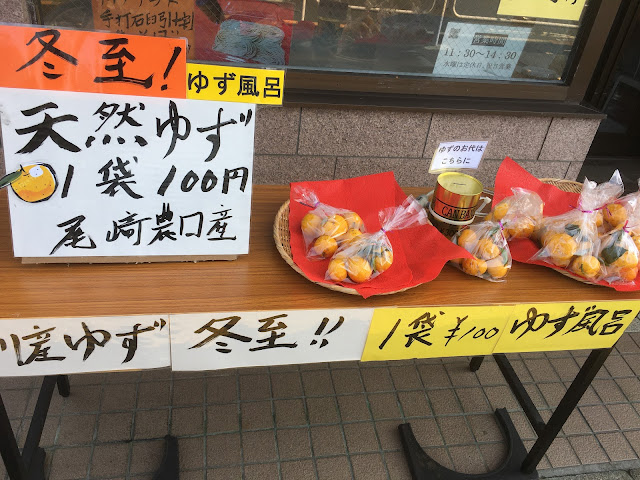
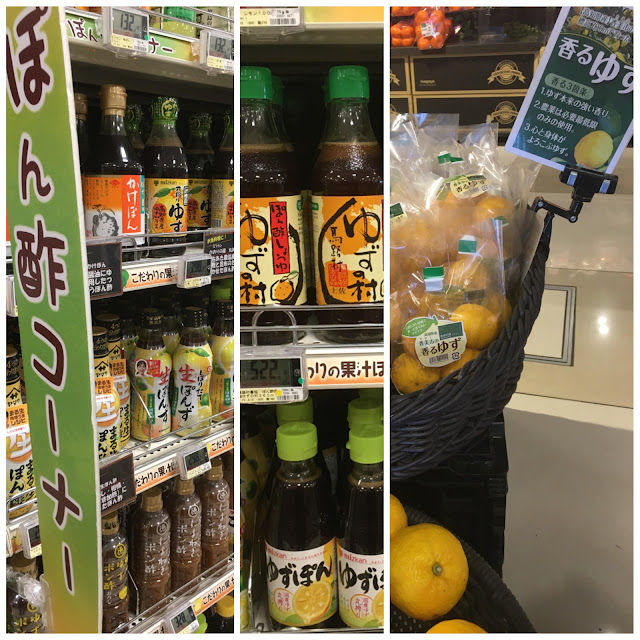
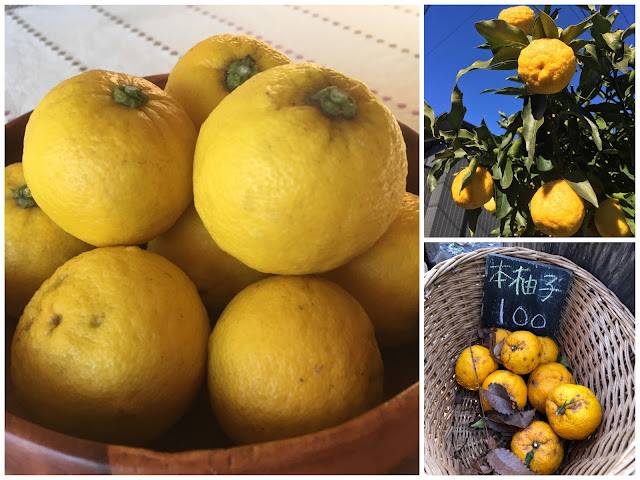
A particularly interesting custom relating to baths comes on the day of the winter solstice (tōji =冬至) when Japanese traditionally put yuzu into the hot water. Yuzu are a small yellow citrus fruit with a thick grapefruit-like pitted skin typically the size of a tangerine though they can be as big as a regular orange. The fruit itself is rather tart/sour with little pulp and lots of seeds so Japanese tend not to eat it directly: it is more commonly used as a seasoning or garnish or to make sweets, sauce, vinegar, tea (available in Starbucks!), cocktails, and jam. Ponzu sauce is a staple at the Japanese dinner table and is used as a dressing or dip for a variety of foods. The name ponzu apparently comes from the no longer used Dutch word pons meaning punch!

The tradition of floating yuzu in the bath water on the winter solstice - sometimes cut or in a cloth bag - apparently goes back to the 18th century. It is said to be both good not only for one's health - preventing colds - but also for the skin and the aroma is also very soothing and relaxing. The custom is also supposed to bring health and good fortune for the coming year as well as warding off evil (not sure about COVID-19 though). The link above has a long list of the amazing benefits of yuzu including antioxidant and microbial properties as well as cardiovascular and circulation improvement.

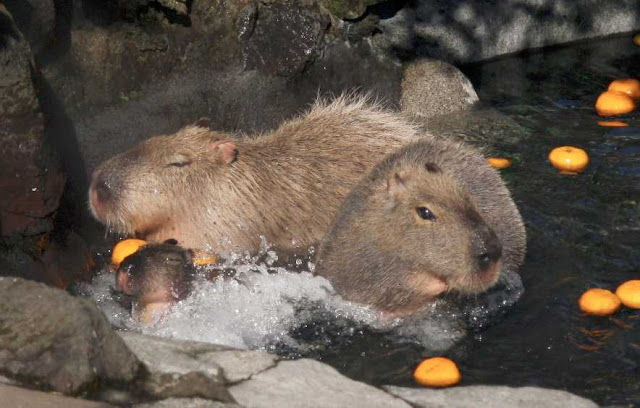
I tried a yuzu bath on the evening of December 22nd, a day of biting northwesterly Siberian winds, and was pleased I did. Not only is the aroma supremely relaxing - I almost fell asleep in the bath - but the skin does feel smoother afterwards and I slept remarkably well that night. However, it is not only humans that enjoy this custom: the Izu Shaboten Zoo is famous for its capybara hot bath where you can watch the giant cuddly rodents - much adored by the Japanese - soaking contentedly among the bobbing Yuzu. Merry Christmas everyone!

Attribution: Flickr user yto (Tatsuo Yamashita) - https://www.flickr.com/photos/yto/3284252557/ (used under CC BY 2.0 licence)

Tuesday, 30 November 2021

Tokyo: City of the Future or City of Confusion?

Tokyo, recently the centre of global attention during the Olympics, is undoubtedly one of the world's great cities. It was recently voted 4th in the Economist's global liveablity index (tied with Wellington), largely due to its high marks for stability, infrastructure, and health care (certainly, it has fared much better during the pandemic compared to many European cities). The name Tokyo itself though is rather confusing since it can refer to different things. While Tokyo Metropolis (Tokyoto=東京都) has a population of over 14 million, the Greater Tokyo Area - which includes a number of surrounding prefectures - has almost 37.5 million residents, which apparently makes it the largest "city" in the world (though it seems a bit ingenious to call such a large area a "city"!). On the other hand, the 23 special wards (ku=区), where a little over 9 million Tokyoites live, are generally seen as Tokyo proper, though just to confuse things further, all 23 of these wards (like Shinjuku) refer to themselves as cities!

The Yamanote Line (山手線) is the almost 35km circular train line that links most of these "cities", including Shinagawa, Shibuya, and Shinjuku. To confuse non-Japanese (and Japanese too for that matter) the direction of travel is not "clockwise" or "anti-clockwise" but outer circle (sotomawari =外回り) and inner circle (uchimawari=内回り). Each station has a unique jingle when the train doors are about to close - if the music is still playing you know you just about have enough time to leap on or off (listen to them all here)! Until recently, there were 29 stations on this loop but in March 2020 a new station - Takanawa Gateway Station (高輪ゲートウェイ駅) - opened between Shinagawa and Tamachi Stations. 

East Japan Railway promoted Takanawa Gateway Station as a futuristic hub, an “ecoste” (Environment Earth Conscious Station) boasting high-level energy conservation through the adoption of origami-inspired roof membranes and the use of cedar-wood from the Tohoku region. It also boasts an unmanned automated convenience store and high-tech facial-recognition equipped AI security robots (though I never saw the latter when I visited - must have been stolen). Controversy dogged the opening of the station: while a public naming competition chose Takanawa as the name, JR East decided on adding the English "Gateway" in an apparent attempt to give it a cool/futuristic/international ring. This was widely panned by the Japanese public and spawned a number of memes and parodies (such as the one here).

Sunday, 31 October 2021

The Impact of COVID-19 on Foreign Residents in Japan: Support Measures and Japanese-Style Multiculturalism

I was recently invited to give an online talk on the impact of COVID-19 on foreign residents in Japan as part of the Waseda Institute of Asia-Pacific Studies Seminar Series run by the Institute of Asian Migrations (IAM), a project research institute at Waseda University. The title was quite a mouthful: "The Impact of COVID-19 on Foreign Residents in 'No Immigration' Japan: Structural Inequity, Japanese-Style Multiculturalism, and the Loss of Social Capital." Not wanting to put off my regular readers, in this post I'm going to give a brief summary of the main points. Any masochists wanting the full presentation can actually watch it HERE on YouTube or read the full paper HERE, though probably not recommended for those of a non-academic ilk! 

I started off the talk with a visual (below) showing the key events relating to the spread of COVID-19 in Japan. This shows the five waves of COVID-19 (with a big jump after the Olympics!) as well as the four state of emergencies (green arrows). One point I highlighted was the re-entry ban for foreign residents - including most permanent residents like me - which ran from April to August 2020. This was seen as discriminatory by many at the time, but I learned after the presentation that the reason was, apparently, due to a lack of PCR test kits. Why the government didn't explain this at the time and instead let discontent fester is rather difficult to understand.

I've talked in other posts above Japan's "No Immigration" Principle, an institutionalisation of the ‘homogeneous people’ ideology of Japanese identity that explains Japan's resistance to migrants and a proper migration policy. The Waseda talk used that as the ideological base to explain the experience of foreign residents during the pandemic. The following figure, based on the content of calls to the Tokyo Metropolitan Government helpline for foreign residents, illustrates the financial and mental impact the pandemic has had on the foreign community in Japan.

In terms of support measures, the government response was refreshingly flexible and inclusive, treating foreign residents, for the most part, the same as Japanese. However, as the diagram below shows, equality is not the same as equity: although, in theory, much support was available, in practice it was often difficult for foreign residents to access these resources due to language and other problems. 

The rest of the presentation focussed on Japanese-style multiculturalism (tabunka kyōsei =多文化共生), a non-integrative exclusionary policy that serves as one of the key barriers in providing equitable support to the foreign community. An extension of the 'homogeneous people' ideology, I discussed how it isolates and disempowers foreign residents, failing to foster the skills and abilities they need to access resources equitably and become fully-functioning independent members of society. Indeed, one of the key themes of the presentation was belonging: about the only time I have ever heard the government acknowledge that we foreign residents are members of society (shakai no ichi'in =社会の一員) was when they wanted us to fill out the census forms. I remember seeing the ad below in my newspaper and nearly choking on my morning coffee: apologies for the coffee stain!