Friday, 23 August 2019

LGBT Issues in Contemporary Japan: The "Ossan's Love" Boom

Today (August 23rd) saw the public release of the film spin-off of TV Asahi drama Ossan's Love (おっさんず・ラブ) which can be roughly translated as "middle-aged guy's/guys' love." Originally a one-off 2016 TV movie which was billed as a hen-ai (変愛) or "strange love" drama on the official site it morphed into a 2018 7-episode late-night "pure love comedy." Although ratings (shichōritsu =視聴率) were low at the time - around 4% - it became something of a cult hit, leading to the movie release (entitled Ossan's Love: Love or Dead). A media blitz and giant posters at stations featuring two of the main characters (pictured) - undoubtedly the first time a "same-sex love" (dōseiai =同性愛) couple had featured so prominently in public - made it something of a cultural phenomenon. Indeed, Ossan’s Love has become one of the top trending words on Twitter in Japan and apparently even topped Twitter’s trending words ranking worldwide consecutively for two weeks during its final two episodes! In June, the messaging app Line - which is like the Asian Whatsapp - released themed stickers which quickly became the most-bought sticker set in Asia.

Some English articles have categorised the series as a "gay drama" but many fans reject such simplistic labelling. It is also frequently lumped together with the much older "Boy's Love" or BL genre (previously called yaoi) of comics geared towards female readers featuring erotic relationships between men, though this is similarly rejected by fans who point out that a kiss scene is as physical as it gets in Ossan's Love. In fact, the word gay (ゲイ) - which usually refers only to male homosexuals in Japan - is never used in the show and it is never clear if the characters are homosexual (though there is one "coming out" scene where one character tells his father he likes men). Indeed, a central theme is one of moving beyond sexuality, reminiscent of the Foucauldian notion that sexuality - the classification of people into gay, straight, bisexual etc - is a relatively recent invention. The key message of the series is how wonderful it is to love someone - hito o suki ni naru koto (人を好きになること)- regardless of sex or age (the series also features a relationship between a young man and an older woman). Given this premise, it is rather surprising that there are no female-female relationships in the series; however, on second thoughts, maybe it is not so surprising given the invisibility of lesbian women in Japanese society (except in the form of male porn).

Does the high public profile of Ossan's Love signal greater acceptance of homosexuality in Japan? Certainly, in the last few years, LGBT issues - and the term itself - have become more visible and mainstream. For example, although the annual Tokyo Rainbow Pride Parade has been running for some 25 years, it is only recently that crowds have swelled and big companies like Sony and Google have become sponsors. Many localities - including Shibuya and 22 others - now recognise same-sex relationships (the so-called "partnership system"). However, at the national level Japan still does not legally recognise same-sex marriage, though a bill was submitted this June, just two weeks after Taiwan became the first Asian nation to recognise it. The ruling LDP is unsurprisingly conservative on this issue, though the other day I saw a rainbow poster (pictured) from the Communist Party promoting gender equality. The party - covered in a previous post - has a pamphlet and an extremely detailed policy page and on their site (both in Japanese) with precise definitions, clear support for same-sex marriage, and proposals to protect the human rights of sexual minorities through anti-discrimination legislation.

The problem is that even among young people, there is little understanding of exactly what LGBT means. When I cover such issues in class - and I start off by focusing on LGB only - it is clear that most students don't know the difference between gender (how "masculinity" and "femininity" are constructed in a particular society) and sexuality (individual sexual preference). A big reason for this is that in Japan, sexuality is usually left unspecified (and unacknowledged): it is conflated with (and often subsumed under) gender. Here, the focus is on gender ambiguity (androgyny) rather than sexuality: transgression of gender boundaries (such as cross-dressing or josō=女装) rather then sexual preference. For example, Japanese words which are commonly translated into English as "gay", such as okama (おかま) and o-nē (オネー)  - literally elder sister - actually denote individuals who act/dress/speak in a feminine way though they may - or may not - be gay. These ideas are explored in more detail in a great chapter by James Valentine available here. But if that is too heavy for you, you can simply enjoy the Ossan's Love film - or binge watch the series on PRIME (with English subtitles). There is also a great list of classic LGBTQ+ Japanese films here.

Monday, 12 August 2019

Keeping Cool in the Punishing Japanese Summer: Traditional and Modern Methods

July may have been the hottest month on record globally, but here in Japan while July was cool August is shaping up to be the hottest on record. It's been day after day of punishing 35℃+ days - with "feels like" heat index readings in the mid-forties - and sleepless 25℃+ nights. People have been really struggling: the Mainichi reported that at least 162 have died from heatstroke so far this summer with over 18,000 sent to hospital in just one week last week. One of the deaths included a worker at a Tokyo Olympic construction site heightening concerns for the athletes next year. Measures such as starting the marathon at 6:00am will not help a great deal when temperatures are already pushing 30℃ in Tokyo at that time.
One consequence of the heatwave has been a drop in productivity - the lateness of this latest blog post is proof of that! Indeed, research shows that heat does make people less productive. Despite the widespread use of air conditioners in Japan, controlling the temperature in the office doesn't actually help people get to work - and in the big cities at least, commuting means walking to and from the station and standing on a jam-packed commuter train. The Tokyo Metropolitan government did start  a campaign last year (2018) to push companies to offer more flexible working hours and also to encourage workers to take earlier trains to avoid over-crowding. The campaign is called Jisa-Biz (時差ビズ  written as 時差Biz) with jisa meaning time-difference (jisa-boke means "jet-lag" for example) and bizu just short for business.

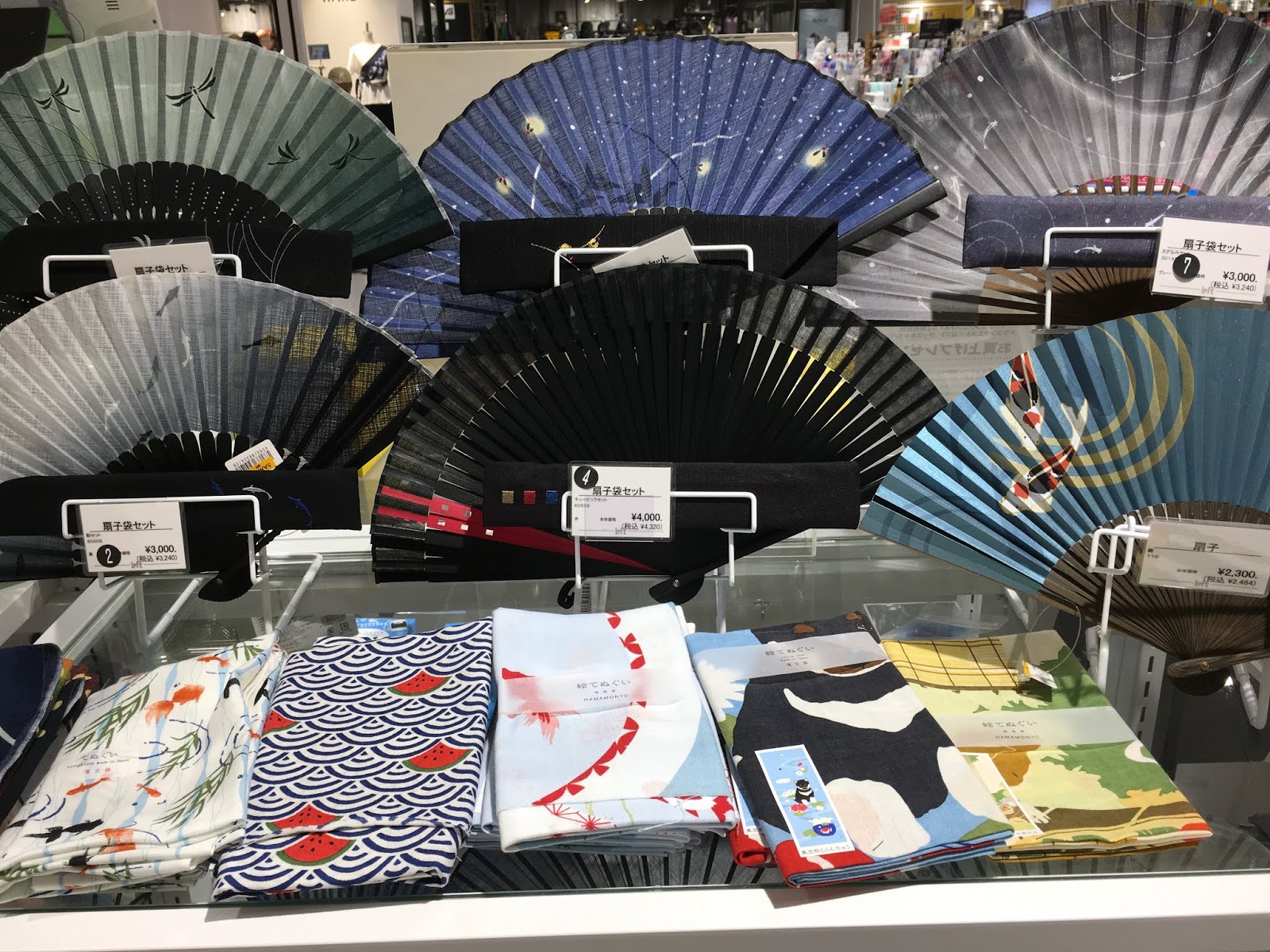
The forerunner of the Jisa-Biz campaign was the Cool-Biz campaign which the Ministry of the Environment initiated in 2005. The idea was to reduce electricity usage by keeping air-conditioners at 28℃; to make this practical companies were encouraged to let employees wear cooler clothes to work, including short-sleeved Hawaiian and Okinawan (Kariyushi) shirts. The campaign transformed into the "Super Cool-Biz" campaign and became a regular feature on the calendar from May to October following the eletricity shortages caused by the triple disaster of 2011. Outside the office, some of the coolest clothing (in both senses of the word) are the traditional summer kimono - yukata - usually made of cotton and worn with sandals. These go perfectly with a hand-dyed tenugui (手ぬぐい) hand-towel made of traditional Japanese fabric that is thin but which absorbs large amounts of water and dries quickly. Larger and longer than handkerchiefs, some Japanese tie them around their neck or head to absorb sweat or even use them to wrap cold plastic bottles.

Keeping cool does not stop at clothes. There are a huge variety of ryōmi (涼味) "cool taste" snacks and drinks to ward off the heat - the picture shows jellies and salt and mineral sweets - not to mention the summer staples of water melon and kakigōri shaved ice. There are also fans of every size and shape: as well as the traditional non-bending uchiwa (pictured) and folding sensu/ōgi fans with summer motifs (like goldfish and dragonflies), there are hand-held electric fans, fans you wear around your neck, and even fans embedded in hats and jackets. Not to mention a "cooling" (rei-kyaku) vest!

Click to preview
A final and rather unique Japanese custom to keep cool is known as uchimizu (打ち水)which involves throwing water onto hot pavements and roads to cool down the surrounding air. This custom, which is promoted as "wisdom from the Edo era," is traditionally carried out using a wooden ladle known as a hishaku (柄杓) and pail (teoke =手桶), though these days a hose pipe is probably more common (the bucket and ladle set is also used when visiting a grave). The traditional custom is backed up by scientific fact: as the water evaporates (jōhatsu=蒸発) it (temporarily) cools the surrounding air by 1.5℃ according to research by the Ministry of the Environment. Under the slogan Uchimizu Biyori ("Perfect Weather for Uchimizu"), the Tokyo Metropolitan Government holds a number of events during the summer months to promote this traditional custom, including one last Saturday in Odaiba (some pictures here). Whether you have the stamina to venture out to attend such an event is a different matter; personally, apart from dog-walking, I'm staying indoors as much as possible!

Saturday, 27 July 2019

Discovering Japan in the UK: Selfish Noodles, Ridiculous Rice-balls, and Manga at the British Museum

The British Museum, London
Just got back from the UK before the latest heatwave hit: Thursday saw the hottest July day on record and the second hottest day ever (38.5℃ in 2003). But even before then everyone was complaining about the heat despite being pleasantly mild compared to Japanese standards (UK houses typically don't have air-conditioning). Here in Japan, July has been unusually cloudy and cool - it experienced an historic low of only 50 hours of sunlight that month - but soon after my return we had the first tropical night (nettai-ya =熱帯夜), a sticky, sultry night in which the temperature doesn't fall below 25℃ (see here for a previous post). And next weekend will likely see the end of the rainy season (tsuyu-ake =梅雨明け);  thereafter, we'll no doubt have to endure a long hot summer of sweltering days and sleepless nights, inter sped only by the odd typhoon or two - probably until mid-September-ish. Compared to this, the summer in the UK - "heatwave" or not - is nothing!

Normal service about everyday life in Japan will be resumed shortly, but for now I thought I'd write a little about the visibility of Japan in the UK. The first thing to note is how ubiquitous Japanese food is. One of the most famous chains is Wagamama, 'Japan-inspired' (but actually very Chinese tasting) Asian cuisine famous for its ramen noodles; most Brits are surprised to learn that the name means selfish or self-centred in Japanese! More generally, sushi is a common lunch choice (below far left) though it is almost always overly-chilled, making the rice dry and hard. In contrast, Japanese convenience stores are careful not to refrigerate rice products, keeping them separate from sandwiches and the like at between 20℃ and 25℃. I also spotted an ad for an onigiri rice ball (below second left) which with its pumpkin topping (not filling) would be enough to make most Japanese recoil in shock! Other Japanese names on chocolates and wine (below right) recall the recent controversy over Kim Kardashian trying to trademark the name kimono for her line of underwear.

© Murakami Takashi
Japanese culture in general is also hugely popular. The British Museum in London (pictured at the top of the page) - which still has free entry - has a permanent gallery sponsored by Mitsubishi which includes a replica of Kudara Kannon, the famous Buddhist statue from Horyu-ji Temple in Nara, a splendid suit of samurai armour, and a 2009 painting by the artist famous for the 'superflat' postmodern art movement, Takashi Murakami, featuring eight members of girl-band AKB48 in manga princess style. There is also a temporary exhibition entitled simply Manga running until August 26th; on the day I visited, the £20 (¥2,700) tickets were already sold out for the day hinting at its enormous popularity. Many reviews have been critical, however: Timeout calls it a "taster" while the Guardian describes it as rather flat. In sum, despite the interest in Japan in the UK, neither food nor comics are as genuine as locals assume; to experience the 'real' Japan, it would seem you have no choice but to actually go there!

Tuesday, 2 July 2019

Growing Rice in the Paddy Fields: Frogs, Ducks, and Dragonflies

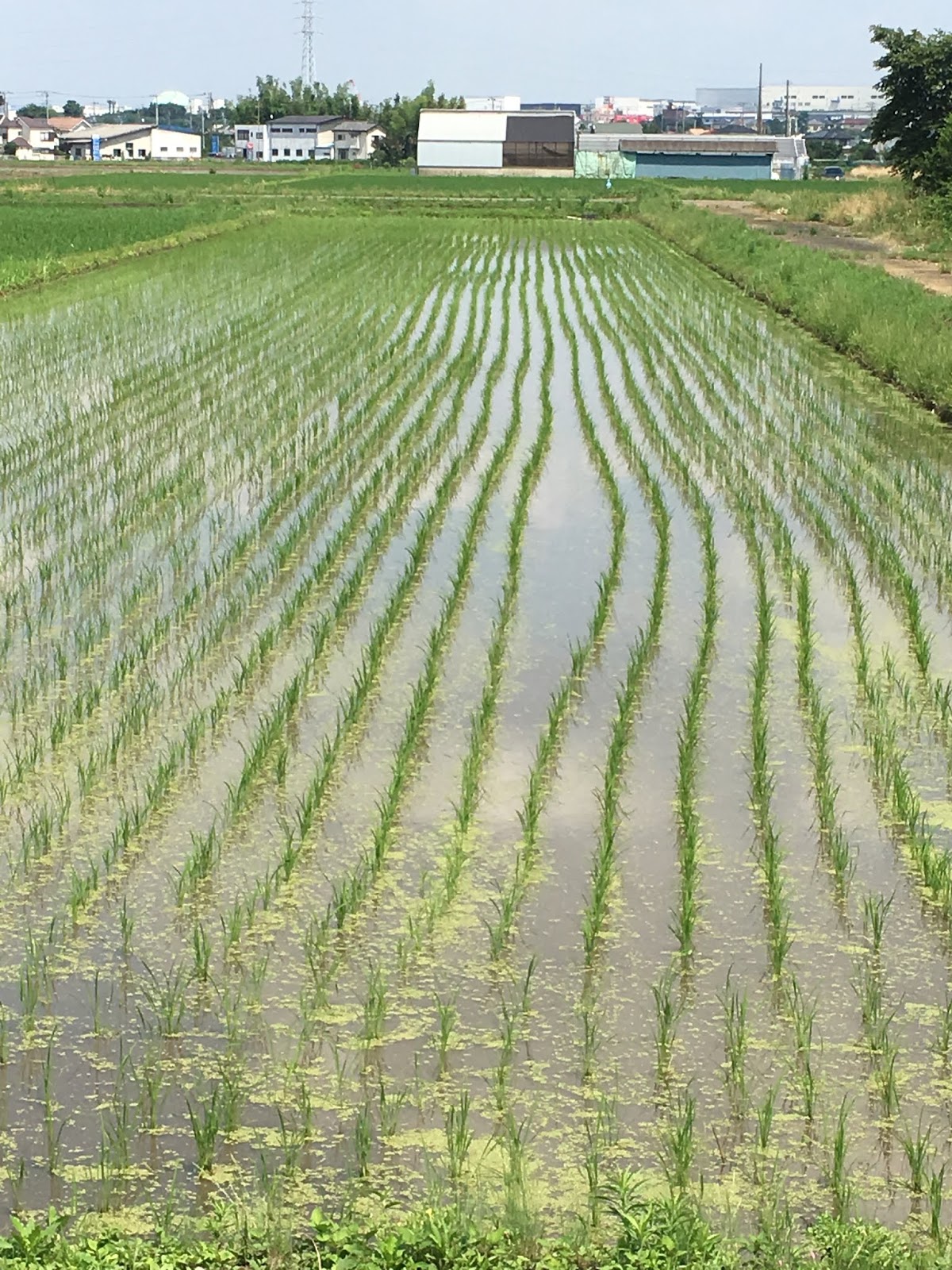
While Europe swelters, Japan remains stuck in the rainy season, though truth be told we haven't actually had that much rain to date. But once the rainy season ends it will be day upon day of hot humid days and sticky tropical nights, so I'm going to take a short break to escape the fierce Japanese summer. With this in mind, this will be the last blog post until the end of July, so I thought I'd write about something typically Japanese - rice! I was inspired after a recent walk through the countryside; it was impressive to see the young rice plants (nae =苗)growing in lines in the flooded paddy fields (tan-bo =田んぼ) - Japan grows rice using the wet cultivation method.
The rice growing calendar generally begins in April (though this varies depending on the latitude of the region). Since this coincides with the start of the school year, many students will learn how to plant and cultivate rice. This starts with "waking up" the fields - preparing a field for planting by flooding it and tilling the soil - something which is known as shiro-kaki (代掻き). The picture above shows children at one school walking through the muddy field bare-foot and hand-in-hand to loosen up the soil and make it easy for the water to filter through. The key is to keep moving or else you'll sink!

The next step is to actually plant the young 4 to 5 inch rice seedlings, known as ta-ue (田植え), which the students do by hand using a string pulled across the field as a rough guideline. Farmers of course do this with machinery!

As the rice grows, water management is key, and most farms will have an elaborate system of irrigation. Because the water level naturally drops, an eye needs to be kept on the field which has to be topped up periodically. Pest control against weeds and bugs is also necessary. Frogs help to keep the pests under control; interestingly, catching tadpoles in the fields is a typical Japanese summer after-school activity for local kids. Another organic way to keep the bugs off the crop is the use of aigamo (合鴨), a cross between a mallard and a domestic duck. Known as the aigamo method, this unique Japanese invention involves releasing ducklings into the field who not only eat weeds and insects but also oxygenate the field as they stir up the soil with their feet! Dragonflies are another paddy field staple; to sit and watch the colourful flyers dart around the field as the breeze makes a gentle sara-sara sound as it caresses the rice-plants is rather incredibly soothing.

Finally, come September or October it's time for ine-kari (稲刈り) or harvesting. This involves draining the last of the water, cutting the stalks, and taking the grain from the rice head - threshing - which is known as dakkoku (脱穀)in Japanese where da(tsu) is to take off and koku means grain. Again, this is usually done in the traditional fashion at school using simple threshing devices such as that pictured. The whole process is extremely labour intensive, so when the new rice (shin-mai =新米) - an official term designated by the Ministry of Agriculture - hits the shops in Autumn, it something of a special event to be celebrated and enjoyed. Itadakimasu!

Thursday, 20 June 2019

Fearful for their Financial Future: Young People, Pensioners, and Don Quijote

One of the surprising things that comes out of survey data on young people in Japan is that they have much lower 'hope for the future' (shōrai e no kibō =将来への希望) than their peers in other countries. For example, 2014 data showed only 66.2% of Japanese youth thought they would be happy when they were 40; in contrast, the figures for the other countries in the survey were all in the eighties. When talking to my students about this anxiety for the future, the key reasons seem to centre on work - low salaries, long working hours - and whether they will be able to receive a pension in the future.

Winning the lottery the best bet?
A recent FSA report on pensions merely fuelled this anxiety. Based on estimates of average living costs, the report highlighted that the public pension would be insufficient and estimated that an elderly couple living until 95 - 30 years after retirement - would need savings of some ¥20 million (£150,000/$185,000) to make up the shortfall. The ¥20 million figure caused a sensation in the media and was quickly disowned by the government: Aso, the finance minister infamous for fine dining and drinking in luxury hotels, said he would "not accept" the report and argued that the pension system "will never collapse." But burying the report doesn't change the fact that the figures were entirely valid: today, the rate of poverty amongst the elderly - currently estimated at around 19.4% - is even higher than the overall figure of 1 in 6 Japanese living below the poverty line (poverty and food banks were discussed in this earlier post).

So how do Japanese save money (setsuyaku =節約)? ¥1000 haircuts and "one coin" (¥500) lunches are one way, but thrifty shopping is surely the most common strategy. The growth of 100-yen (hyaku-en) shops in particular has been dramatic in the last twenty years, and at the same time as department stores have been struggling, thrift-chains like Daiso have been thriving selling cheap - but nevertheless reasonable quality and hugely diverse - products. Cosmetics in particular are hugely popular both among both Japanese and tourists, who buy bucket-loads as souvenirs! It's not only cosmetics either - there's loads of other products perfect for souvenirs, such as origami, toys, study materials, and snacks (see here). The picture below shows some other unique products: special decorative envelopes Japanese use for giving money at weddings and funerals; chopsticks, including special ones to teach children how to hold them properly; and a massive selection of bento boxes!
Talk of discount shopping wouldn't be complete without mentioning Don Quijote (ドン・キホーテ) usually abbreviated to Donki. Donki is a discount chain store which came into its own following the bursting of the economic bubble at the beginning of the 1990s: today there are over 160 stores in Japan, with others in Singapore, Thailand, and Hawaii. The stores are usually massive, open late, and full of all sorts of weird and wacky products, including anime goods and cosplay-style costumes. As you walk into the store, there is a sign that says kyōyasu no dendō (驚安の殿堂). This literally means "surprisingly cheap palace", though the kyōyasu is a made-up word: the Donki homepage explains that in contrast to the usual word for dirt-cheap, gekiyasu (激安), kyōyasu is supposed to capture the thrill/excitement/overflowing surprise at the cheap prices. I suspect, though, that for the millions of pensioners struggling to get by - and the youngsters fearful of never receiving a pension at all - the feeling is probably more akin to relief at somehow just being able to get by.

Sunday, 9 June 2019

Moss: The Miracle Plant Perfectly at Home in Humid Japan

Friday saw the official start of the rainy season (tsuyu =梅雨) in Tokyo which means 4 or 5 weeks of high humidity (over 90% this morning!) - and clothes that never seem to dry. As someone who cycles to work I headed to Mont Bell in Shibuya to get some decent rainwear. Whereas rain and humidity are both pretty unwelcome for cyclists like me, for one of Japan's signature plants - moss or koke (苔) - it is a boon.

The Japanese climate is particularly well-suited to moss, though it is more the humidity than the rain. Moss is apparently able to absorb water and nutrients directly from the air if humidity is 80% or more; it also releases moisture if the humidity drops too low, meaning it is both a humidifier and a de-humidifier (see here for more)! To top it all, it also purifies the air, absorbing pollutants. This may explain its growing popularity, both outside - Japanese gardens are abundant in moss and the air there does always seems fresher - and inside. Kokedama (苔玉)- a ball of soil wrapped in moss and held together with string or wire, from which an ornamental bonsai-style plant grows - can be seen all over the place these days and kokedama workshops are a real craze.
 Japan's moss obsession has been a popular topic in the media. This article links it back to a best-selling 2011 book by Hisako Fuji which triggered a wave of moss-viewing parties and tours, particularly popular amongst women. The forest at the base of Mount Kita-Yatsugatake surrounding Lake Shirakoma (白駒の池) in Nagano Prefecture is often mentioned as the perfect spot. But one does not need to go far to find beautiful moss; any local temple or shrine Japanese garden will have it. Saiho-ji (西芳寺) in Kyoto, otherwise known as Koke-dera (moss temple), is probably the most famous example. The interesting thing is that moss is prized here and left to naturally cover ancient statues rather than be removed like it might be in the West: in other words, in Japan, grass will be pulled out from moss, the very opposite of what happens in the UK! The very length of time it takes to cover stone is considered something magical - as the lyrics in the national anthem highlight; indeed, a key element of the Zen garden is the concept of wabi-sabi or "transient imperfection." The pictures above, taken in the 17,000㎡ Japanese garden behind the Nezu Museum in Tokyo, show this well.

But this post wouldn't be complete without mention of my favourite fast-food shop in Japan - Mos Burger. The "Mos" actually has nothing to do with the green stuff - it means Mountain Ocean Sun apparently - but it does proudly promote the healthy nature of its meat and veggies, with pictures of where and who grew the particular products. Most stores will also have a little noticeboard which changes daily, with friendly comments and observations from the staff giving a very warm neighbourhood feel to the stores. It's no surprise that it's the second biggest fast-food franchise in Japan - I would rate the taste better than McDonald's which is miles ahead in first place. As you can see from the menu here, there are a lot of unique Japanese style burgers on offer - including teriyaki and rice burgers - though my absolute favourite has to be Mos Chicken: amazing rain or shine!

Saturday, 25 May 2019

Extended Golden Week: Zushi, Enoshima, and Kamakura (Part 2)

In the last post, I introduced Zushi, a small sea-side city a couple of hours from Tokyo just to the east of Kamakura. While it is widely known that Kyoto, where the emperor resided, was the old capital of Japan until it moved to Tokyo in 1868, fewer people know that Kamakura was the other 'old capital', one that was home to Japan's first military government or shogunate (bakufu =幕府) which ruled from 1192 to 1333. Friction between Kyoto (where the emperor resided) and Kamakura (home to the shogunate) saw frequent conflict - effectively civil war - until the overthrow of the shogunate in 1333 though conflict continued between two competitors to the imperial throne until 1392.

Today, Kamakura is a bustling tourist-packed city full of shrines and temples reflecting its historical importance. The city may be smaller than either Kyoto or Nara but it has a long history that goes back to even before the shogunate; Tsurugaoka Hachimangu Shrine in the center of the city was built in the year 1063. This "shrine" has both Buddhist and Shinto features reflecting the fact that until the Shinto and Buddhism Separation Order (神仏判然令) of 1868 the two religions were mixed. Tsurugaoka Hachimangu shows plenty of traces of its shrine-temple (jingū-ji =神宮寺) history in its layout and architecture. Starting from the coast, there is a long straight 1.8km road that climbs up to the Shrine at the top of the hill. When I was there I was lucky enough to see a Shinto wedding taking place: in the video at the bottom you can see the bride with her tsuno-kakushi headwear (introduced here) serenaded by traditional court musicians playing gagaku (雅楽) classical music on flutes and pipes (the vertical panpipes-like instrument is called shō or 笙).

Walking back from Tsurugaoka Hachimangu you can take the famous  Komachi-dori Street a narrow street packed with souvenir shops and some 60,000 visitors a day. It has become so crowded with foreign tourists that authorities have had to crack-down on eating while walking - seen as bad manners in Japan - following complaints from businesses (somewhat ironic given that these businesses are the ones selling the food in the first place!). One of the best-selling snacks is the Buddha soft cream (pictured) which is presumably acceptable to eat while heading towards the famous Big Buddha. There are actually quite a few Big Buddhas (daibutsu =大仏) in Japan, with the most famous being the one in Nara. The Big Buddha here is neither the oldest nor the tallest (13m) but the fact that it sits in the open air and can be viewed inside is pretty unique - not to mention that it is also the subject of a poem by Rudyard Kipling!

Sunday, 12 May 2019

Extended Golden Week: Zushi, Enoshima, and Kamakura (Part 1)

Zushi Marina, Kanagawa
Japan recently enjoyed an extended "Golden Week" holiday to mark the abdication of the old emperor and the succession of the new (discussed in an earlier post). May 1st, the first day of the new emperor's reign known as the Reiwa era, became the additional holiday which worked out as ten consecutive days off (April 27th to May 6th) for many - but not all - people. Golden Week is probably the longest vacation period of the year for many Japanese and with the extra day many did take advantage of this to travel inside and outside Japan (despite the crowds and higher prices). I enjoyed a trip to nearby Zushi, Kanagawa, a small sea-side city sandwiched between Kamakura and Yokosuka (home to the US naval base) only a couple of hours from the capital.
The weather wasn't especially kind during our stay, but we did have some blue skies (as the picture shows) and the beach was rather lovely (our dog, Jaz, especially enjoyed digging holes!). The beach was actually the setting for former Tokyo mayor's debut novel Taiyō no Kisetsu (太陽の季節)which translates as Season of the Sun but became Season of Violence in the English translation, better reflecting the content which was about the rebellious post-war taiyōzoku youth culture. Interestingly, the Sunshine Party was also the name of Ishihara's short-lived nationalist political party.
In the evenings, the Zushi Beach Film Festival was in full swing and despite the rain quite a few people turned up to enjoy the huge screen and state of the art sound system. The booming speakers are a rarity on the beach - in 2014 the city banned loud music, tattoos, drinking, and barbecues after complaints by local residents. The crackdown on rowdy party goers and yakuza (two gangsters were  stabbed to death on the beach in 2013) saw a 50% drop in the number of visitors in 2015.

In the next post, I'll introduce Kamakura, the old capital of Japan and its wonderful temples and shrines. But for now I'll finish with a picture of Enoshima, a small offshore island a little further on from Kamakura introduced in an earlier post. Driving towards Enoshima along the coastal road the rolling storm clouds - completely hiding any view of Mount Fuji - contrasted vividly with the blue sky and crashing white foam. Breathtaking.

Monday, 29 April 2019

Japan as a Country of Surveillance: Crime, Cameras, and Cards

One thing I have noticed recently is the proliferation of surveillance cameras which have begun to pop up all over the place. Whereas in the past these were typically found only at places like stations, public buildings, shops, and convenience stores, today they are in the most innocuous locations, stuck to the top of lamp-posts on quiet streets with a sign at the base warning passersby that 'crime-prevention cameras' (bōhan kamera =防犯カメラ) are in operation. In the UK, one 2013 survey put the number of CCTV (closed circuit television) cameras at between 4 and 6 million, an average of one for every 13 people. In Japan, however, there are no official statistics, though an article in the Nikkei Shimbun in 2012 put the number at around 3 million. Today the number is surely closer to that of the UK.

Of course, Japan has a famously low crime rate and recorded crimes have been at record lows in recent years, falling below 1 million after a peak of 2.85 million in 2002. A boost in police numbers has certainly contributed but the spread of security cameras is undoubtedly another key factor (in 2016 more than half of all criminal charges were apparently based on surveillance camera footage!). With the rugby world cup this year and the Olympics in 2020 efforts to up surveillance, such as the introduction of cameras on trains, are even more noticeable. The Tokyo Metro site here details the new poster campaign to give foreign visitors 'international level peace of mind' (世界トップレベルの安心).
The price to be paid a safe society is a great deal more surveillance and less privacy than one might experience in the UK. I have previously written about Japan's 'friendly authoritarianism' characterised by groups such as local neighbourhood associations and citizen patrol groups who are encouraged to keep an eye on comings and goings in the community. We are also encouraged to register our name and address at the local police box (kōban). And, the Big Brother Kabuki-style 'moving eyes' (ugoku bōhan no me) sticker warning that crime will not be overlooked (minogasanai =見逃さない) is fairly ubiquitous - including on the back of 100,000 vehicles, such as soft-drink delivery trucks, in the Tokyo area. An alternative slogan is frequently seen on the back of mama-chari bicycles warning potential kidnappers that their children are being watched over attentively (mimamotteiru =見守っている). See here for an interesting article about when these stickers were created and by who.
Foreigners in particular - there is a strong 'foreign crime' discourse in Japan - may find such an environment disconcerting, especially when it means getting stopped by a 'friendly' officer for police questioning. But it is not only non-Japanese who have become shaken by Japan's intensified surveillance regime. The Secrets Protection Law (Himitsu Hogo Hō=秘密保護法) which came into effect in 2014 to guard 'specially designated state secrets' was controversial enough to mobilise Japan's usually sleepy civil society. Then, in 2016 Japan's Supreme Court ruled that blanket surveillance of Muslims in the country was not unconstitutional. The following year, in a Japan Times interview, Edward Snowden warned that the new conspiracy law of the same year moved Japan a step closer to achieving sweeping surveillance of ordinary citizens while in June of this year the scope of crimes that can be investigated using wiretaps was expanded. Finally, the 12-digit Social Security and Tax Number system know as 'My Number' (マイナンバー) which was introduced at the end of 2015 to streamline tax, pension, and welfare raised a number of privacy concerns; to date, more than half of the Japanese have still not obtained a card (which, in theory, remains voluntary). Quis custodiet ipsos custodes?

Sunday, 14 April 2019

Reception at the British Embassy: Cherry Blossoms, Chandeliers, and Bilateral Relations

With the cherry blossom peak over, the petals (hanabira =花びら) are falling which makes for a lovely sight on the waterways (such as Meguro Rover) in Tokyo as they blanket the water, with "flower-rafts" (hana-ikada =花筏) as they are called in Japanese. I got the chance to see the blossoms at their peak though last week when I visited the British Embassy for a reception for alumni from Durham University in the UK living in Japan. It was my first visit to the embassy, located across from the Imperial Palace moat or Hanzo-Hori lined with beautifully illuminated cherry trees (though the direction signs at the station - "Embassy of British" - could have done with a native-speaker check, like many instances of English on signs in Japan!). The cherry blossoms in the ambassador's garden were stunning; Japanese readers may be surprised to know that people in the UK also enjoy the blossoms at this time of year (though it is usually too cold to eat and drink under the trees...).
Most of the guests were Japanese who had come from all over Japan - from Hokkaido to Kyushu - for the chance to take a peak inside the luxurious Ambassador's Residence. The Ambassador's garden (pictured) was of course wonderful but the living room, decked out with antique furniture, chandeliers, and pictures of royalty was something else. The invitation was also written in very formal English, with "lounge-suit" for the dress code and "carriages" denoting the end of the reception (translated rather blandly as heikai=閉会 on the Japanese version). It was also interesting to see that the Japanese invitation added the explanation that there was to be a stand-up buffet, written as risshoku (立食). This is not to be confused with tachi-gui (立ち食い) which, though using the same kanji, denotes cheap and quick stand-up noodle shops and other street stalls!

Official Japan-British relations only began in 1854 with the Anglo-Japanese Friendship Treaty (日英和親条約) signed after the end of the "closed-country" (sakoku=鎖国) period though relations deteriorated rapidly during the 1930s (see here for a full time line). Today, relations are remarkably close: during Abe's visit to the UK in January, Prime Minister May described the two countries as "natural partners. Thriving, innovative, island nations – committed to defending the global rules." Brexit appears to have thrown a bit of a spanner in the works though, and Honda's announcement in February that it was withdrawing from the UK shocked many Brits. Japanese, though, remain pretty unfazed; an internal embassy poll apparently found that only about 40% of Japanese even know Brexit is happening! Certainly, there is a lot of love for the UK - especially tradition and pomp and ceremony - in Japan; September will see the launch of a new 'UK in Japan' campaign, beginning with the Rugby World Cup and continuing through to the Tokyo Olympics.

Click to preview
Click to preview
For those want to learn a little more about early diplomatic relations between Britain (and other European nations) and Japan, I would recommend British author David Mitchell's The Thousand Autumns of Jacob de Zoet which is set on the man-made island of Dejima between 1799 and 1817. While the story of a Dutch clerk on an isolated trading post is a lot more exciting than it sounds (!), for those of you wanting a more modern neon-Tokyo-yakuza-filled adventure, number9dream is probably more your cup of tea (the bowling alley scene still sticks in my mind...). The detail in both books makes it clear that the author knows Japan well (indeed, he lived in Hiroshima for eight years) - he is also married to a Japanese.