Last week saw a night out with friends to one of the ubiquitous karaoke boxes which are generally clustered around train stations in Japan. This reflects the fact that they are a cheap (and warm) place to stay if you've missed your last train (most karaoke boxes close around the time of the first train). There are various chains but the biggest is Big Echo and like many other places this offers a variety of differently decorated rooms, food, percussion instruments, wi-fi, DVD recording, and even cosplay. We paid around \1500 (£10/$14) per person which included free non-alcoholic drinks from a self-service drinks bar and unlimited time, something of a bargain.
Regular snapshots of everyday life plus musings on Japanese culture and society for Japanese language learners and Japan lovers in general. Subscribe for email notifications when a new post goes up or send me a request (on the right panel). Comments are also welcome (link below each post).
Tuesday, 27 February 2018
Karaoke Boxes: Destroying the Myth of the Quiet, Shy Japanese
Amongst the hundreds of Japanese words which have made it into the Oxford English dictionary many remain unfamiliar to the average Brit - think hikikomori, karōshi, and otaku for example. Karaoke, though, is familar to absolutely everyone and some even know that the word comes from kara (meaning empty - the same kara as in kara-te or empty hand) and an abbreviation for "orchestra" (ōkesutora in Japanese). One interesting thing is how the pronunciation changes in English: mysteriously the Japanese ke and ka sounds often morph into a ki sound in English, so karaoke is typically pronounced kari-oki (just like kara-te is often pronounced karati by English speakers). It is not only the pronunciation that is different though: karaoke is a completely different cultural activity in Japan, one that takes place in a private sound-proof karaoke box with friends (or colleagues) not a public space in front of strangers as in the UK. Karaoke has lost some of its popularity in recent years: from a peak for around 58m customers and almost 15,000 outlets in 1995, 2016 saw that fall to 47m and 9,484 with one reason being the rise in solo (hitori) karaoke.
Last week saw a night out with friends to one of the ubiquitous karaoke boxes which are generally clustered around train stations in Japan. This reflects the fact that they are a cheap (and warm) place to stay if you've missed your last train (most karaoke boxes close around the time of the first train). There are various chains but the biggest is Big Echo and like many other places this offers a variety of differently decorated rooms, food, percussion instruments, wi-fi, DVD recording, and even cosplay. We paid around \1500 (£10/$14) per person which included free non-alcoholic drinks from a self-service drinks bar and unlimited time, something of a bargain.
When I first came to Japan, you had to leaf through thick books of songs and then enter the number directly into the machine, but now you simply search and enter a song or artist name (or just a keyword) into an ipad like device (pictured) and you're good to go. There's plenty of English songs too - tens of thousands of songs in fact. At the end of a song you get a kcal score which is apparently the amount of energy estimated to have been used (though for us this seemed totally random!). Japanese friends may ask you to sing your "Number 18" (juhachi-ban =十八番) meaning the song you sing best, so make sure you have one ready! The expression "Number 18" apparently has its roots in kabuki.
A unique and unforgettable feature of Japanese-style karaoke are the videos that play as you sing along. A few songs do have the official video playing but most of the time you will get some terribly corny C-movie-type video playing that (very very) loosely corresponds to the song theme. These videos more often that not seem to be set in the UK and feature "actors" who appear to be randomly recruited passers-by. The fact that there must be a whole cottage industry somewhere that creates plot lines and recruits "actors" for these videos is one of the ongoing mysteries of life in Japan. Nevertheless, the videos add to the whole karaoke experience, an experience which sees normally quiet, shy friends and colleagues transform into screaming frenzied rock 'n' roll stars (usually helped by a beer or three). Vive le rock!
Last week saw a night out with friends to one of the ubiquitous karaoke boxes which are generally clustered around train stations in Japan. This reflects the fact that they are a cheap (and warm) place to stay if you've missed your last train (most karaoke boxes close around the time of the first train). There are various chains but the biggest is Big Echo and like many other places this offers a variety of differently decorated rooms, food, percussion instruments, wi-fi, DVD recording, and even cosplay. We paid around \1500 (£10/$14) per person which included free non-alcoholic drinks from a self-service drinks bar and unlimited time, something of a bargain.
Posted by
Chris Burgess
at
21:27
| Share this post: | Email ThisBlogThis!Share to XShare to FacebookShare to Pinterest |
Labels:
everyday
Tuesday, 20 February 2018
Tokyo Skytree: The World's Tallest Tower
The Skytree, at 634 metres, is currently the tallest free-standing broadcasting tower in the world and the second tallest structure, though is not on the list of tallest buildings because it fails to meet the condition of having "continuously occupiable floors." The height itself is well known by most Japanese because the numbers 6, 3, and 4 can be read "mu", "sa", and "shi" the name of the ancient province that includes modern day Tokyo. Ticket prices depend on how high you want to go: it'll cost you ¥2,060 to go up to the Tenbo Deck (340-350m) and another ¥1,030 to go all the way to the Tenbo Galleria (Tenbō Kairō=展望回廊) at between 445-450m. At the moment there is a special asa-wari (朝割) or morning discount deal for weekdays from 8:00 to 9:30am (but these need to be bought in advance).The lifts are the fastest large capacity lifts in Japan at 600m/minute which will get you to the Tenbo Deck in 50 seconds! Be warned though that you may have to queue a while - however a fast track ticket is available (at a premium price). But if you want to save some money, there is an alternative: the observatory at Tokyo Metropolitan Government Building in Shinjuku is not quite as high but you can still see Mount Fuji on a sunny day - and best of all it's free!
Posted by
Chris Burgess
at
21:55
| Share this post: | Email ThisBlogThis!Share to XShare to FacebookShare to Pinterest |
Labels:
everyday
Tuesday, 13 February 2018
Valentine's Day Japanese Style: Friendship, Obligation, or Love?
One of my very first posts when the blog started last March introduced White Day, the day when men give gifts to women as a thank-you for the gifts they received today, Valentine's Day. Valentines Day in Japan, in contrast to the UK, is an exclusively one-way affair, with women giving chocolate to men. In that earlier post, I explained that there are three kinds of Valentine gifts: (1) tomo (friend) choco typically exchanged by schoolgirls and often handmade, (2) giri (obligation) choco usually
given to co-workers in an office or perhaps to a teacher as a sign of
thanks - or just because everyone else is doing it - and the much rarer
(3) honmei (true feeling) choco given with romantic intent.
This year there have been a couple of interesting advertising moves. One is encouraging people to buy chocolates as a treat or reward for themselves (watashi ni gohōbi o =私にご褒美を). The second, perhaps related development, was Belgium chocolate company Godiva's full page newspaper ad calling on Japanese (women) to stop buying giri choco (Nihon wa giri choco o yameyō =日本は義理チョコをやめよう). The text focuses on the stress giri choco causes women who "have to spend mental energy and money" on buying chocolates for all their male colleagues "for the sake of smooth relations at work."
It's going to be difficult to change ingrained social habits, especially considering the important place giri (social obligation or duty) has in Japanese society, though some bosses have reportedly been telling their subordinates to stop the giri choco practice. In contrast, however, tomo choco seems to be going from strength to strength. As explained above, in contrast to the lack of "pure feelings" (to quote Godiva) typical of the commercial giri choco, tomo choco is more a labour of love, a platonic gesture celebrating friendship by giving (usually) hand-made (te-zukuri =手作り) customised chocolates to friends. At the moment, our kitchen is filled with boxes of Oreos, white Ghana bars (a popular brand of creamy chocolate), and packs of cream cheese which apparently will soon miraculously transform into 120 Cookies and Cream Truffle balls (recipe here). These will be carefully placed in individual decorated bags (available from any ¥100 shop at this time of year) and given out to friends at school on the day. In return they will bring back a mountain of the most varied hand-made cookies and chocolates you can imagine, carefully eaten over the next few weeks (and rarely shared with parents!).
This year there have been a couple of interesting advertising moves. One is encouraging people to buy chocolates as a treat or reward for themselves (watashi ni gohōbi o =私にご褒美を). The second, perhaps related development, was Belgium chocolate company Godiva's full page newspaper ad calling on Japanese (women) to stop buying giri choco (Nihon wa giri choco o yameyō =日本は義理チョコをやめよう). The text focuses on the stress giri choco causes women who "have to spend mental energy and money" on buying chocolates for all their male colleagues "for the sake of smooth relations at work."
Posted by
Chris Burgess
at
17:03
| Share this post: | Email ThisBlogThis!Share to XShare to FacebookShare to Pinterest |
Labels:
food&drink
Sunday, 11 February 2018
Keeping Warm in Winter: Musical Kerosene Trucks and Tragic Conflagrations
| Kerosene Truck: Note the kanji ki (危) meaning danger |
Posted by
Chris Burgess
at
16:07
| Share this post: | Email ThisBlogThis!Share to XShare to FacebookShare to Pinterest |
Labels:
everyday
Friday, 2 February 2018
Throwing Beans and Driving off Demons: Setsubun
| Supermarket flyer promoting Setsubun |
| The special giant sushi/meat/vegetable roll known as ehō-maki (恵方巻き) on sale in a 7-11 store |
Posted by
Chris Burgess
at
19:09
| Share this post: | Email ThisBlogThis!Share to XShare to FacebookShare to Pinterest |
Labels:
food&drink,
tradition
Thursday, 25 January 2018
First Snow in Tokyo: Zao Ski Resort and Kotatsu
![]() |
| Garden Lantern (tōrō) |
The sound of the snow chains making a shan-shan jangling sound on the tyres of buses and trucks always takes me back to my time in Yamagata, Tohoku, which marked the start of my life in Japan. The snow was unlike anything that I seen before in North-west England and I had to learn quickly how to walk properly! One common activity during the winter was yuki-kaki (雪かき) or snow shovelling, also called josetsu (snow removal=除雪), which saw all the neighbours band together to clear the snow in front of their houses and shops. During my time in Yamagata, one of the things I enjoyed most was taking the bus at weekends to Zao ski resort where I would rent skis and spend the whole day enjoying the web of slopes and courses (and in the process teaching myself to ski - very badly). Mount Zao is actually a volcano on the border between Yamagata and Miyagi prefectures with the ski resort and famous hot springs (onsen) on the Yamagata side. One of the biggest tourist attractions are the so-called "snow monsters" (jyuhyō =樹氷), frost covered trees which look amazing especially when illuminated at night. Zao was actually the location for world-cup ski jumping last week and is highly recommended for expert and beginner alike.
As the conclusion to this snowy story let me introduce one of Japan's most well-known and loved children's songs: Yuki (snow) which is popularly called Yuki ya Konko (雪やこんこ) supposedly meaning snow falling though linguistically it doesn't make a lot of sense in modern Japanese. The lyrics and a translation can be seen here. My favourite line is undoubtedly the last, one that perfectly catches a typical indoor Japanese winter scene: neko wa kotatsu de marukunaru (猫はこたつで丸くなる) - "the cat is curled up under the kotatsu." A kotatsu is a low heated table covered with a quilt which, given that most Japanese houses don't have central heating, serves as a cosy refuge during the cold months. Highly recommended!
Posted by
Chris Burgess
at
13:05
| Share this post: | Email ThisBlogThis!Share to XShare to FacebookShare to Pinterest |
Friday, 19 January 2018
New Year Decorations going up in Smoke
| Mochi sticky rice cakes |
Posted by
Chris Burgess
at
21:58
| Share this post: | Email ThisBlogThis!Share to XShare to FacebookShare to Pinterest |
Labels:
tradition
Sunday, 14 January 2018
Nengajō New Year Greeting Cards and Otoshidama
New Year's greeting cards - known as nengajō (年賀状) - are something of an institution in Japan and after coming back from the first shrine visit of the year (hatsumōde) on January 1st it's exciting to open one's mailbox and check the pile of cards that have (hopefully) arrived. Even after this date cards continued to arrive in dribs and drabs; the latest date they are supposed to arrive is January 7th. Much like sending Christmas cards in the West, the custom of sending cards to people who have helped you throughout the previous year - or just people you want to keep in touch with - is a key part of the New Year holiday. It's a tricky business though working out who to send cards to - and anticipating who you might receive cards from - and inevitably you'll receive cards from people you didn't send one to: cue a mad rush to find spare cards and get them sent off post-haste! Apparently, 2,599 million cards were issued for 2018 which works out at about 20 cards for each man, woman, and child in Japan!
Like many Japanese, we usually buy blank postcards specially made for ink-jet printing and create our own customised cards: since this year is the year of the dog, our own dog, Jaz (Instagram@jasmin.the.dog), was featured on the 2018 card (pictured). This is fairly common, and most people add pictures of family and pets as a way of updating friends on what happened during the previous year. Our cards contained the standard new year greeting in red at the top: akemashite omedetō gozaimasu (明けましておめでとうございます) followed by the ubiquitous but untranslatable Japanese phrase asking for indulgence in the coming year (kotoshi mo yoroshiku onegaishimasu =今年もよろしくお願いします). For a great explanation on how and what to write on a nengajō see here.
The excitement of nengajō is not yet over though: each card has a special unique number at the bottom (pictured) and January 14th (today!) is chūsenbi (抽選日) or raffle drawing day. The lucky winners will get a New Year's gift or otoshidama (お年玉) a word which typically refers to money given in small envelopes to children by relatives and visitors. You can see the winning prizes and numbers here: did I get anything?
Like many Japanese, we usually buy blank postcards specially made for ink-jet printing and create our own customised cards: since this year is the year of the dog, our own dog, Jaz (Instagram@jasmin.the.dog), was featured on the 2018 card (pictured). This is fairly common, and most people add pictures of family and pets as a way of updating friends on what happened during the previous year. Our cards contained the standard new year greeting in red at the top: akemashite omedetō gozaimasu (明けましておめでとうございます) followed by the ubiquitous but untranslatable Japanese phrase asking for indulgence in the coming year (kotoshi mo yoroshiku onegaishimasu =今年もよろしくお願いします). For a great explanation on how and what to write on a nengajō see here.
The excitement of nengajō is not yet over though: each card has a special unique number at the bottom (pictured) and January 14th (today!) is chūsenbi (抽選日) or raffle drawing day. The lucky winners will get a New Year's gift or otoshidama (お年玉) a word which typically refers to money given in small envelopes to children by relatives and visitors. You can see the winning prizes and numbers here: did I get anything?
Posted by
Chris Burgess
at
08:46
| Share this post: | Email ThisBlogThis!Share to XShare to FacebookShare to Pinterest |
Labels:
tradition
Thursday, 11 January 2018
The Festival of Seven Herbs: Seasonal Food in Japan
Posted by
Chris Burgess
at
15:11
| Share this post: | Email ThisBlogThis!Share to XShare to FacebookShare to Pinterest |
Labels:
food&drink,
tradition
Saturday, 6 January 2018
The first Shrine Visit of the Year: Hatsumode
2018 is now upon us, also known as the year of the dog (inu-doshi =戌年). 2018 is also the penultimate year of Heisei in the Japanese calendar - Heisei 30 - since the abdication of the emperor in May 2019 will bring with it a new (as yet unannounced) era. Most Japanese are now back at work but during the holidays - especially the 1st, 2nd, and 3rd of January - many made a point of visiting a shrine to make their prayers and wishes for the new year, a practice known as hatsumōde (初詣) made up of the characters for "first" and "make a pilgrimage". Indeed, although most of the shops were shut during this period, trains were crowded with people and two or three hour queues were not uncommon at some of the most popular shrines.

Personally, I like to avoid spending hours queueing with thousands of others at a popular shrine like Meiji Shrine (=Meiji Jingu) in Shibuya (which reportedly sees three million visitors in the first three days of January!) and instead paid a visit to my local neighbourhood shrine (pictured). There's even a bilingual poster explaining how to pray properly at the shrine captured in three easy steps: two bows or ni-hai (二拝), two hand-claps or ni-hakushu (二拍手), and one bow or ippai (一拝). Typically people throw a coin - 5 yen is supposed to bring luck in romance - into the wooden box (saisen-bako =賽銭箱) before these steps. You can also ring the shrine bell to alert the deity to your presence after making your offering. For a more detailed explanation see here.
After praying, if you choose to buy a lucky charm (omamori) or fortune paper (omikuji) from the shrine shop you'll probably be served by a young woman wearing a white top and red hakama trousers with her hair tied back in a decorative clasp. These women are known as miko (巫女) or "shrine maidens" in English and act as assistants to the priest, often part-timers at busy times, though in the past they were powerful shamans. The video below was taken by a friend at the famous Iwashimizu Hachimangū Shrine (石清水八幡宮) in Yawata City, Kyoto Prefecture (京都府八幡市) and shows a traditional shrine maiden's ceremonial dance (miko-mai =巫女舞) or kagura (神楽) on New Year's Day (see here for an official video).
Posted by
Chris Burgess
at
21:55
| Share this post: | Email ThisBlogThis!Share to XShare to FacebookShare to Pinterest |
Labels:
tradition
Saturday, 30 December 2017
New Year's Cleaning: Decluttering the KonMari way
In Britain we have spring cleaning but in Japan the major cleanup takes place at the end of the year in schools, temples, and homes, and is known as ōsoji (大掃除), literally big cleaning. Ōsoji needs to be finished before December 31st, known as ōmisoka (大晦日) in Japan. In the home, this usually consists of cleaning oven hoods, sweeping balconies, washing windows, and dusting everywhere. Once the cleaning has been completed, the house is considered "pure" enough to put up New Year decorations such as kadomatsu (a bamboo/pine decoration) to welcome ancestral spirits or kami. Only then can holiday festivities can be enjoyed with a clear conscience!

A key part of the clean-up is getting rid of unwanted stuff and in this respect "organising consultant" Marie Kondo has been remarkably influential (indeed she was was one of Time's "100 most influential people" in 2015). Her 2011 book Jinsei ga Tokimeku Katatsuke no Maho (人生がときめく片づけの魔法) was a massive bestseller and has been published in over 30 countries. The 2014 English version was followed by a 2016 sequel and a 2017 manga, the former titled "Spark Joy" drawing on the verb tokimeku in the original Japanese which can be variously translated as to throb, flutter, or palpitate. The basic idea is to take a category-by-category approach (such as clothes or books) and focus on what you want to keep rather than want you want to throw away; anything that "sparks joy" should be kept and given a proper place that is both visible and accessible.
Given the combination of small houses and a consumerist and gift-giving culture, it is no surprise that the KonMari method (こんまり式) has been something of a revelation in Japan. In the neighbourhood, it's very common to see storage containers or "trunk-rooms" which you can rent out to store the stuff that won't fit in your house (pictured). People who can't afford to do this - or who can't bear to throw anything out - simply hoard and in recent years the increase in the issue of so-called "garbage houses" (gomi-yashiki =ゴミ屋敷) where rubbish has been overflowing onto the street has become something of a social problem. Indeed, there are even specialist companies which clear out such houses in cases of the increasingly common case of solitary death (kodoku-shi =孤独死).
This will be the last post for 2017, so let me leave with you a couple of common greetings used around this time of year. If it's still 2017 I can say yoi otoshi o (よいお年を) which means (I hope you) have a good new year (holiday); if you're reading this in 2018 then I will wish you a very happy new year which is akemashite omedetō gozaimasu (明けましておめでとうございます) - shortened to akeome among friends!
Given the combination of small houses and a consumerist and gift-giving culture, it is no surprise that the KonMari method (こんまり式) has been something of a revelation in Japan. In the neighbourhood, it's very common to see storage containers or "trunk-rooms" which you can rent out to store the stuff that won't fit in your house (pictured). People who can't afford to do this - or who can't bear to throw anything out - simply hoard and in recent years the increase in the issue of so-called "garbage houses" (gomi-yashiki =ゴミ屋敷) where rubbish has been overflowing onto the street has become something of a social problem. Indeed, there are even specialist companies which clear out such houses in cases of the increasingly common case of solitary death (kodoku-shi =孤独死).
This will be the last post for 2017, so let me leave with you a couple of common greetings used around this time of year. If it's still 2017 I can say yoi otoshi o (よいお年を) which means (I hope you) have a good new year (holiday); if you're reading this in 2018 then I will wish you a very happy new year which is akemashite omedetō gozaimasu (明けましておめでとうございます) - shortened to akeome among friends!
Posted by
Chris Burgess
at
12:34
| Share this post: | Email ThisBlogThis!Share to XShare to FacebookShare to Pinterest |
Thursday, 28 December 2017
The Old Ladies' Harajuku: Red Pants in Sugamo
Posted by
Chris Burgess
at
14:58
| Share this post: | Email ThisBlogThis!Share to XShare to FacebookShare to Pinterest |
Saturday, 23 December 2017
Christmas in Japan: Romance, Chicken, Cakes, and Gifts
Posted by
Chris Burgess
at
18:38
| Share this post: | Email ThisBlogThis!Share to XShare to FacebookShare to Pinterest |
Labels:
food&drink,
tradition
Wednesday, 20 December 2017
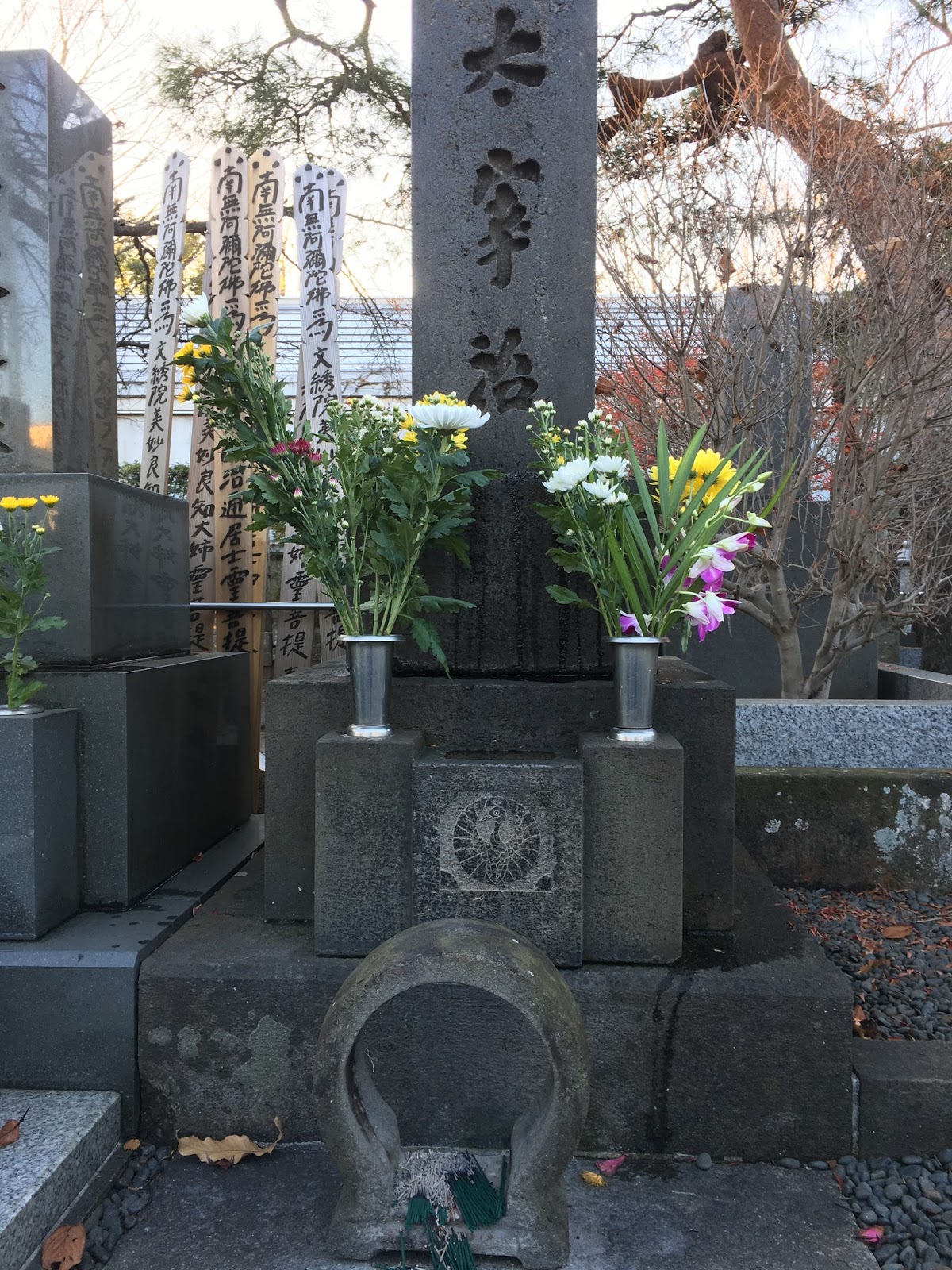
Osamu Dazai and Suicide in Japan
![]() |
| Lifeline Poster at a train station |
The seriousness of the situation was brought home when nine dismembered bodies were found at an apartment in Zama City last month, all young people (including three high-school girls) who had expressed suicidal thoughts on social media and had subsequently been lured to the killer's apartment. The incident underlined the inadequacy of support and prevention programmes for suicide in Japan despite a 2016 revision of the Basic Law on Suicide Prevention. Telephone lifelines (inochi no denwa =命の電話) in particular are woefully under-funded and under-staffed; it can take up to 20 attempts to get through to a Japanese lifeline (which is then usually limited to 20 minutes). Moreover, COVID-19 has seen support groups having to cut back support raising fears of a spike in deaths during the period of isolation. For the English speaker (of whatever nationality) in Japan, there is an alternative that is still active during the pandemic: TELL (Tokyo English Lifeline) is Japan's only English-speaking lifeline and also offers a online chat at weekends. For more on suicide in Japan and what can be done, see the remarkable documentary "Saving 10,000" available here. "Sometimes all you need to save somebody’s life," concludes the film-maker, "is to take the time to listen."
Posted by
Chris Burgess
at
14:45
No comments:
| Share this post: | Email ThisBlogThis!Share to XShare to FacebookShare to Pinterest |
Labels:
tradition
Subscribe to:
Comments (Atom)