Showing posts sorted by date for query moon. Sort by relevance Show all posts

Friday, 31 July 2026

Braving the Summer Heat in Japan: Playing Pickleball at Tokyo Tower

Attractions at Haneda Airport: Godzilla, Torii gate with Edo painting, and Tanabata Display

BritishProf has been on his travels, first to the UK, and more recently to Karuizawa, the mountain resort town famous for escaping the summer heat. For the UK, I flew from Haneda Airport, just south of central Tokyo, MUCH more convenient than Narita. Haneda has expanded and developed substantially in recent years, and was recently named the World's Best Domestic Airport and recognised for having the World's Best Accessible Facilities at the World Airport Awards. The new Terminal 1 North Satellite is set to open in September 2026 boasting Japan's first hybrid wood-steel terminal structure and promising to improve passenger flow and reduce bus gate usage for domestic operations. In short, if you're flying to or from Tokyo, domestic or international, Haneda is by far the best option: not to mention it also has interesting displays such as the world's largest indoor Godzilla monument, artworks (the picture features the 17th century Cooling Off or 納涼図屏風 by Kusumi Morikage), and seasonal events (such as the interactive Tanabata festival corner which encouraged travellers to write their hopes and dreams on colorful strips of paper called tanzaku).
 
Japan has certainly heated up considerably since I first flew out from Haneda, and despite temperatures in England reaching record highs, they are nothing in comparison to the consecutive 35 degree plus days and 80% humidity which has become the norm in Japanese summertime. The Cooling Off sketch mentioned above, featuring a family of three enjoying an evening breeze and gazing at the moon, makes one yearn for the end of summer, and the painting itself does indeed hint at the coming autumn with its rising full moon and the ripening gourds growing on the vines on the trells. For now, though there is nothing to do but brave the heat but one can at least enjoy some of the delightful summer blooms such as the water lily, properly known as the Indian/Sacred Lotus (Hasu in Japanese) , with its gorgeous pink flowers.
 
Keeping fit in the dog days of summer is tough, but for a light workout at an interesting venue why not try pickleball at Tokyo Tower? The white and red lattice communications tower was famously inspired by the Eiffel Tower: at 333 metres it is just 3 metres taller than its French rival! It was the tallest tower in Japan and one of Tokyo's main tourist attractions until the opening of the 634 metre Tokyo Skytree in 2012. Tokyo Tower's two observation decks remain popular though: the two-story 150 metre Main Deck (¥1500) and the smaller almost 250 metre Top Deck (¥3500). A final tourist attraction is the five-story base building known as FootTown which houses a number of restaurants, gift shops, and other attractions, including two pickleball courts at the top (RF). Pickleball is unique mix of tennis, badminton, and table tennis and is played with a solid paddle and a perforated plastic ball on a badminton-sized court with a lowered net. While first introduced to Japan only in 2014, it enjoyed a surge in popularity following a 2024 tournament held at Ariake Tennis Park; the Tokyo Tower Pickleball Court opened in July 2025 and in 2026 the two leading organisations in Japan merged to form one governing body, Pickleball Japan. It was my first time playing, but it was easy for beginners to pick up and not too strenuous. The only problem was the wind, with the ball - essentially a light plastic ball with holes - really being affected by the gusts. Maybe playing half way up Tokyo Tower was not a good idea after all! Any experience with interesting or unusual sports inside or outside Japan? Let us know in the COMMENTS!

Sunday, 31 May 2026

Yokosuka City, Navy Curry, and the first Samurai from England

The Golden Week holidays (April 29~May 6th) seem long gone though, like last year, my highlight was probably picking green tea and rolling the leaves myself to make tea leaves. Interestingly, the price of tea has skyrocketed in recent years due to the worldwide popularity of matcha, with exports more than doubling. May 2nd, the 88th day since the start of the spring lunar calendar, marked the official arrival of the season for newly harvested tea. However, since it started getting warm in mid-March, green tea harvesting began much earlier in many places. Now, the heat has suddenly ramped up with 1,000 people reportedly hospitalized with heatstroke in the week through May 17th and one elderly woman dying. In Hita City, Oita, temperatures reached 35℃ on May 18th, the earliest ever that the temperature in the city has surpassed the 35-degree mark. Britain too has seen similar crazy temperatures in May; the big difference though is that almost all Japanese households have air-conditioning while very few (15%?) of UK ones do. 

One potential getaway during the dog days of summer is the Miura Peninsula where the coastal sea breezes make the heat much more bearable than inland. Recently, I stayed in a unique little commune-type town atop a hill overlooking Yokosuka (横須賀), a major port which was famously the landing site where Commodore Matthew Perry arrived in 1853, leading to the opening of Japan. Today, the city is most widely known as the 568-acre home of the largest overseas U.S. Naval installation in the world, which it shares with the Japan Maritime Self-Defense Force (JMSDF). The city boasts a unique, international atmosphere but is probably most famous in Japan for its culinary staple, Navy Curry, which was adapted from the British Royal Navy in the 19th century. A recent article in the Guardian describes how it "conquered hearts" in Japan to become "a national obsession". Interestingly, the JMSDF now has a tradition of eating curry for lunch every Friday which reminded me of the British tradition of eating fish on a Friday (fish and chip shops apparently double their sales on a Friday!).

For those wanting to stay in the area and sample the food - not only curry but amazing sea food too - I recommend On Stay (bookable on airbnb.jp) located in an area called Tsukimidai (月見台=moon viewing terrace), a former municipal housing complex built in 1960 in the hills of Taura in Yokosuka City (B3 on the map). After the last tenants moved out in 2020 all 58 homes became vacant, but a community revitalization project involving the renovation of these buildings began in 2023, restoring the place into a charming new town with some 40 restaurants, cafes, studios, workshops and boutiques. Reborn as a “Nariwai Living Town” - in Japanese, nariwai means “livelihood” or “one’s way of life,” representing a lifestyle where living, working, and creating are seamlessly integrated - it has become a close community where homes double as small businesses, integrating daily life and work. Personally, I loved the vibe of the place and the unique, idiosyncratic individuals who came from all walks of life but had found their ibasho (居場所), a comfortable, welcoming community where everyone was accepted without judgment, far away from the rat race. 

Finally, before I get too misty eyed about future retirement, let me recommend one historical spot to visit in Yokosuka. Many people are familiar with the story of William Adams who became the first Englishman to reach Japan in 1600, some two hundred and fifty years before Perry. Those who have seen or read Shogun will know him as John Blackthorne, the protagonist in James Clavell's novel who was directly inspired by the English navigator. His Japanese name, Miura Anjin ("The Pilot of Miura"=三浦按針), comes from the estate in Miura (present-day Yokosuka) he was given by the Shogun. Until recently, there was some dispute over where he was buried: Hirado, Nagasaki, not too far from where he originally ran ashore, or Tsukayama Park, Yokosuka, matching his final wishes to be laid to rest looking out over Edo Bay. The latter contains the Anjin-zuka (William Adams Monument), two memorial stone towers for him and his wife (pictured). However, in 2020, researchers from the University of Tokyo confirmed that bone fragments in an urn in Hirado belonged to William Adams making the Yokosuka site a cenotaph - a memorial monument containing no remains - rather than a grave. Nevertheless, it is still moving to visit the site where the first samurai from England spent most of his life. Have you read or seen Shogun? Feel free to add a COMMENT!

NOTE: The Yomiuri Japan News carried a special feature on the Tsukimidai Housing Complex (2026/06/24 page 16) - they must be reading my blog! 

Friday, 31 October 2025

An Autumn Potpourri: Pampas Grass, Pac-Man, Ed Sheeran, and the Yamanote Line's 100th Anniversary

With falling temperatures, the red spider lilies (higan-bana) introduced last month have completely disappeared to be replaced with another natural seasonal signpost, Japanese pampas grass (susuki), otherwise called (Chinese) silver grass, zebra grass, or porcupine grass. In the calendar, susuki is most commonly associated with jyūgoya (十五夜) or the night of the full moon, that is the night of the 15th day of the 8th lunar month​ in the old calendar (equivalent to October in the modern calendar - October 6th this year). On this day, some people display susuki - said to bring a year's good health - together with dango (rice-dumplings) and engage in "moon watching" (tsuki-mi =月見), the celebration and honouring of the autumn full-moon which goes back centuries. See here for my previous post on moon-watching!

Autumn is connected with a host of relaxing indoor activities, epitomised by phrases such as dokusho no aki (読書の秋) meaning "Autumn is for reading" and shokuyoku no aki (食欲の秋), literally autumn, the season of good appetite! There is no expression for video games but these are also a popular autumn pastime. Interestingly, to coincide with Halloween, Google recently marked the 45th anniversary of Pac-Man with a playable game on its search engine. Pac-Man was invented by a Japanese, Toru Iwatani, a designer at Namco (now Bandai Namco Entertainment) and originally released in 1980. The story is that he was inspired by a pizza with a slice missing and aimed to create a non-violent video games that would appeal to a wider audience, including women who Iwatani's team apparently thought, in the best tradition of autumn in Japan, "liked to eat!" 

The blog is always looking to make connections between Japan and the UK and here I'm going to make a leap and talk about Ed Sheeran, the hugely successful English singer-songwriter whose favourite restaurant is apparently The Araki, a nine-seater
sushi bar in London which offers an omakase chef's set menu at £310 (
¥63,000). Omakase means to leave something up to someone else to decide (a very useful phrase to know!). But the connection doesn't end there: recently the Toei Oedo subway line (大江戸線) in Tokyo held a unique collaboration with Sheeran featuring themed subway cars, a stamp-rally, merchandise, and even a one day travel pass. The logo for the subway line is a magenta circle with an "E" inside which has been neatly transformed into "Ed" for the campaign! Magenta is also the colour of Sheeran's new album "Play."

While we're on the subject of subways, November 1st marks the 100th anniversary of Tokyo's fabled Yamanote line (山手線), the almost 35km circular train line that connects most of the key areas such as Ueno, Shinagawa, Shibuya, Shinjuku, and Ikebukuro (video here). To confuse non-Japanese (and Japanese too for that matter) the direction of travel is not "clockwise" or "anti-clockwise" but outer circle (sotomawari =外回り) and inner circle (uchimawari=内回り) - go figure!  Each station has a unique jingle when the train doors are about to close - if the music is still playing you know you just about have enough time to leap on or off (listen to them all here)! 

Following the opening of a new station - Takanawa Gateway Station (高輪ゲートウェイ駅) - in March 2020, the one-hour loop now comprises 30 stations, with 50 trains running three or four minutes during rush hour and carrying almost a million people each day. In comparison, the Circle Line in London consists of 36 stations and a "full loop" takes about 49 minutes, though it is no longer a true continuous loop. Figures for Circle Line only are not available, but the average daily ridership for the whole Tube network was 3.23 million for 2023/2024! See here for some of the anniversary merchandise on sale, including a commemorative bento, a Fukagawa rice ball (onigiri), and a limited-edition craft beer! British Prof doesn't drink, but I'd still like to raise a glass to the Yamanote which makes Tokyo travel so seamless and meeting up with friends so very easy. Kanpai! Anything piqued your interest this month? Do drop us a line in the COMMENTS!

Thursday, 31 October 2024

Celebrating Autumn: Moon Viewing, Tsukimi Burgers, and Rabbits Pounding Mochi

Temperatures have finally started to fall in Japan, though having said that I am still yet to use the heater at home and the window remains open as I write this. The heat this year has indeed been unprecedented, with summer temperatures the joint hottest on record. Moreover, we are still waiting for Mount Fuji's first snowcap - which on average appears around October 2nd - making it the latest since records began 130 years ago. The snowcap is one seasonal marker in a country where people are acutely aware of nature and appreciate the changing of the seasons. Probably the clearest seasonal marker this time of year is the moon.

Full moon over Tsuda
In autumn, Japanese enjoy Tsukimi (月見), literally "moon-viewing", a celebration of the full moon (jyūgoya =十五夜) - also known as the harvest moon (chūshū no meigetsu=中秋の名月) - which traditionally falls on the 15th day of the 8th lunar month​ in the old calendar (September 17th this year - though the actual full moon fell on the 18th). As I have written before, various seasonal foods and decorations feature during the festivities. But while foods such as rice dumplings (dango), sweet potatoes (satsuma-imo), and chestnuts (kuri) traditionally feature, Tsukimi burgers have become something of a new tradition in recent years.

MacDonald's Tsukimi burger has been available as a limited autumn item since 1991. The story was that the McDonald's team developed a burger with an egg and intended to call it simply "bacon cheese and egg burger" but the president stepped in and insisted it be called the Tsukimi burger, much to the marketing teams' horror. However, the name struck a chord with consumers and today every burger shop in Japan - including KFC and Mos Burger - has their own variation, and even pizza and beef-bowl (gyūdon) chains have jumped on the bandwagon. This year's lineup, which is only available from September 4th to mid-October, can be seen here (short CM here). One new item on the menu this year is the Custard Pudding Flavour Tsukimi McShake with "golden hues to represent the moon" - which begs the question, what colour do the Japanese actually see the moon?

©copyright McDONALD’S (日本マクドナルド株式会社)(Link)

Whereas in the UK the moon is typically painted silver, blue, or white, in Japanese children's drawings the moon is often painted in yellow or orange, just like the egg yolk in the Tsukimi burger. The image of the moon as yellow or orange nicely illustrates how culture can have an influence on colour perception (previous blog discussion here). Admittedly the moon does tend to look orange or amber (just like the sun appears redder) when rising or setting, so maybe this has become the dominant image for the Japanese (and, yes, Japanese kids paint the sun red not yellow!).

To investigate more on how the moon is perceived in Japan, I visited The Museum of the Imperial Collections, Sannomaru Shozokan (皇居三の丸尚蔵館) in Chiyoda Ward, Tokyo to check out their exhibition entitled Nature’s Splendor: Scenes of the Moon and Water (水の情景・月の風景), an exhibition "exploring the beauty of the natural world through the lens of two of its most admired subjects." Interestingly, the moon was coloured white in all the exhibits, which suggests the perception of it as yellow is either a modern invention or just for children. The highlight of the exhibition - also featured on the poster - is undoubtedly the set of three hanging scrolls called Snow, Moon, and Flowers (雪月花)depicting elegantly dressed Heian ladies admiring the most beautiful features of the season: snow in winter, the moon in autumn, and cherry blossoms in spring. The piece, completed in 1937 by Shoen Uemura, apparently took 21 years to complete.

As a final aside, eagle-eyed readers may have noticed rabbits featuring on the McDonald's Tsukimi milk shake; at the exhibition too, there was a vase, apparently created for Emperor Taisho's enthronement in 1915, featuring a circle representing the moon and a rabbit holding a pestle. Why? Well, rabbits are a common motif to symbolise the moon in Japan because when Japanese see the moon, they see two rabbits pounding rice-cakes (mochi)! Coincidentally, the word mochi-zuki (望月) means both full moon and also sounds like the phrase for pounding mochi, mochi-tsuki (餅つき), a Japanese tradition to greet the new year. For this reason, rabbits - which are considered creatures that ward off evil - and mochi feature a lot during Tsukimi season festivities. Can you make out the shapes of the rabbits when you look up at the moon? Let me know in the COMMENTS!

Tuesday, 31 October 2023

High Skies, Sardine Clouds, Reading Week, and Margheritas: Autumn has Come!


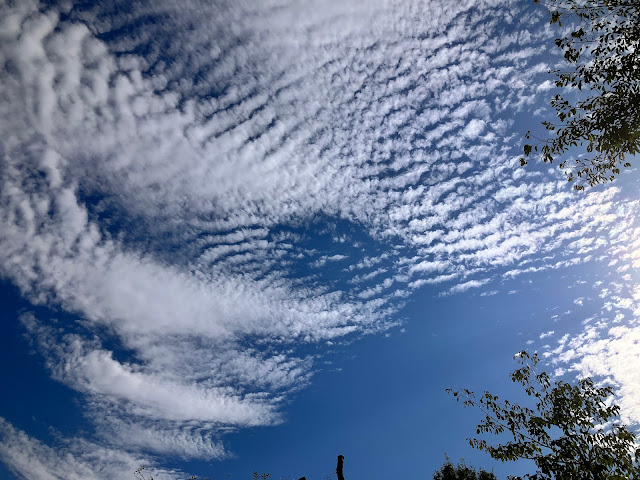
We're almost into November, but pleasant days (and short-sleeves) continue, perhaps not surprising given we had the hottest summer on record. At the same time, the sky tells us that autumn (aki=秋)has well and truly arrived. The Japanese have a lovely saying for this season, sora ga takai (空が高い) - literally, "the sky is high." Indeed, a famous (originally Chinese) proverb reads 天高く馬肥ゆる秋 (ten takaku uma koyuru aki), literally "autumn, the sky is high and the horse fat" (the latter part pointing to a successful harvest). Even my weather app comments on the sky being high: the attached picture notes that, "today the clear autumn sky (akibare=秋晴れ) feels to be high." Although this expression is not found in English it is true that the sky is more blue at this time of the year, due to the humidity level dropping off leaving less moisture in the air. Cirrocumulus autumn clouds are also described as resembling fish scales (uroko-gumo=うろこ雲) - sometimes called sardine (iwashi-gumo) or mackerel (saba-gumo) clouds -  just like the English expression "mackerel sky" referring to rows of clouds displaying an "undulating, rippling pattern similar in appearance to fish scales."
©読書推進運動競技会
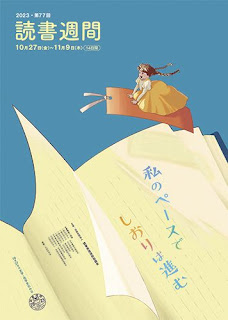
While season words (kigo=季語) are a staple in Japanese poetry, surprisingly clouds don't figure so much. The only one I found was this by Basho, though unusually the season is clearly identified: この秋は 何で年寄る 雲に鳥 (In this autumn/why do I get old?/ birds in clouds). Much more common are references to the moon, which in contrast to the "high" sky, often appears to sit low to the horizon, as well as being brighter, at this time of year (moon-watching or tsukimi used to be a popular group activity in autumn in Japan). Autumn in Japan is also associated with a number of other activities. One is reading, as expressed in the phrase dokusho no aki (読書の秋) and a special reading week (dokusho shūkan=読書週間) started on October 27th (though it actually runs for two weeks!). Thought to be a post-war phenomenon perhaps inspired by US Children's Book Week, others trace the phrase back to Natsume Soseki quoting an old Chinese poem about "reading by lamplight." Autumn is also promoted as a time to engage in sport and outdoor activity, probably due to the fact that schools typically hold their sports day (undō kai=運動会) during this season. Indeed, the national holiday held on the second Monday in October is called Sports Day (スポーツの日), a holiday originally established to commemorate the 1964 Tokyo Olympics. 

Nevertheless, the most common refrain one hears about autumn is the phrase shokuyoku no aki (食欲の秋) - literally autumn, the season of good appetite! While foods such as saury (sanma), matsutake mushrooms, persimmons (kaki), and pears (nashi) deserve an honorable mention, the holy trinity is probably sweet potatoes (satsuma-imo), pumpkin (kabocha), and chestnuts (kuri) - see here for a simple video on how to make aromatic chestnut rice (kuri-gohan), an autumn staple. Given the popularity of Japanese food worldwide, you might expect that Japanese people would favour eating out in Japanese restaurants but in fact Italian food is first choice for many Japanese for a nice meal out - and there are so many great options. For those of you in Tokyo, Fukuoka, or Yokohama, you have to try L'Antica Pizzeria da Michele, founded in Naples in 1870 and boasting possibly the best Margherita in Japan! And on that note, let me wish all my readers a belt-busting autumn - and do let me know in the COMMENTS what the season means to you, culinary or otherwise!

Wednesday, 29 July 2020

Pictures of Japan's Floating World: Natural and Physical Beauty in Ukiyo-e

For those starved of culture during the lockdown, the reopening of the Tokyo Metropolitan Art Museum on July 23rd featuring a brand new ukiyo-e exhibition was a moment for celebration. The museum is located in Ueno Park which contains a host of other world class museums as well as Ueno Zoo and some impressive temples and shrines (plus the famous statue of "Last Samurai" Saigo Takamori covered here and the rather lovely Shitamachi museum introduced here). The entrance to the Metropolitan Art Museum is famous for the giant stainless steel sculpture entitled “my sky hole 85-2 light and shadow” created in 1985 by Bukichi Inoue which magically reflects everything around it.

So what are ukiyo-e? Ukiyo-e are basically woodblock prints for mass consumption created during the Edo period (1603-1868). The term "ukiyo" (浮世) is made up of the characters for "floating" and "world" and carries the sense of transient, hedonistic everyday pursuits enjoyed by ordinary people during what was a peaceful, thriving period in one of the world's biggest cities. Much like modern fashion/celebrity magazines, they featured beautiful courtesans, famous Kabuki actors, and strapping sumo wrestlers - the style leaders of the time. Starting off as black ink prints, colour was gradually introduced together with Western style perspective. Later prints featured some stunning landscapes, such as Great Wave off Kanagawa by Hokusai probably the best known ukiyo-e print in the world. In these landscapes, nature and climate become an important element: in particular, the snow/moon/flower (setsu-gekka =雪月花) theme, representing (like haiku) the seasons of winter, autumn, and spring (cherry blossoms) crops up quite regularly.

Morning snow at Yoshiwara, Moon over Sumida River, and Viewing Cherry Blossoms along the Sumida River all by Hiroshige. From Library of Congress (no known restrictions on publication - see Jim Breen's position on copyright here)

Another thing I noticed while looking over the 450-odd pictures in the exhibition was the obsession with beauty and the "ideal" Japanese woman. In fact, hair styles aside, the ideal appeared to change very little from Moronobu's 1680 "Two Lover's Embracing" through Kitagawa's 1792-93 "Three famous Beauties" (pictured) to Kikukawa's early 19th century "July". Invariably, women were represented as having a doll-like beauty, tall, willowy, graceful, and elegant with an elongated face, narrow, widely spaced eyes, a long, flat nose, and large ears which were always visible. Eyebrows were usually high and artificial - or completely shaved off (apparently the sign of adulthood, marriage, and/or having a child - see here). Lips were tiny, painted rouge, and consistently pursed shut - no smile or teeth are to be seen (though Kitagawa does have a picture of a woman blackening her teeth here).

A final noticeable feature of the bijin-ga (beautiful woman pictures) is the pure white (irojiro =色白), smooth, unblemished skin. In the age of Black Lives Matters, it might be tempting to jump to the conclusion that this reflected a Caucasian ideal; however, ukiyo-e predates the phenomenon of akogare or adoration/looking up to the West: Western (white) beauty as the ideal, as seen in the portrayal of Japanese with Caucasian features and fashion, only began during the Meiji Era (1868-1912). Russel notes that the Japanese have traditionally viewed their skin as white, only later coming to see themselves, at least rhetorically, as members of “the yellow race." One reason that was said to be considered beautiful at this time, not only in Japan but across Asia, was the fact that those working outdoor in the rice fields tended to have darker skin, denoting a "lower class." As you ponder whether beauty is indeed skin deep, I'll leave you with one of my favourite ukiyo-e which shows that humour too was a feature of many of the images!
Utagawa Kuniyoshi's "Young Woman who Looks like an Old Lady"

Sunday, 22 December 2019

Celebrating Christmas in Japan: Christians, Christmas Trees, and Xmas Illuminations

Tsuda Christmas tree under the Cold Moon
In the last two posts (here and here) I introduced Umeko Tsuda, a campaigner for female education in Japan who founded the women's university where I work today. Umeko was baptised as a Christian at age 7, a year after she arrived in America, and her Christian faith remains a key underlying principle at the university with compulsory classes such as "Introduction to Christianity" (キリスト教概論), a Christmas service (reihai=礼拝) every year in the chapel, and a giant Christmas tree (pictured). In fact, despite the small number of Christians in Japan - some 1.9 million or 1.5% of the population - there are a surprisingly large number of Christian schools and universities, the latter including Sophia, Rikkyo, and ICU (International Christian University), as well as Aoyama Gakuin and Doshisha (which Umeko's father, a strong proponent of the Christianisation of Japan, played a prominent role in establishing).

None of these universities insist on students being Christian, though some prefer full-time teachers to be Christian. ICU, for example, explains that it is "not a proselytising institution" and does not see nurturing Christians as its main goal though its mission is "the establishment of an academic tradition of freedom and reverence based on Christian ideals." Nevertheless, students from Christian High-Schools entering under the recommendation system (キリスト教校推薦) need to be either baptised or "seeking the way" (kyūdōsha=求道者). The relatively large number of prestigious Christian institutions of higher education has produced a significant number of Christian educators and politicians in Japan - including eight Christian prime-ministers.

Despite the low number of Christians in the general population, Japanese have firmly embraced Christmas as a secular cultural event. Almost 60% of Japanese eat something special to celebrate Christmas - chicken and sponge cake are the big-sellers as described in an earlier post - while 55% of Japanese put up a Christmas tree, Christmas wreath, or other seasonal decorations. 3.9% even illuminate their house though for most Japanese illuminations are something they go out to see at Christmas. Indeed, illuminations featuring millions of colourful LED lights are one of the standout attractions in Tokyo during the winter: Timeout lists more than 30 here with the most famous one probably being Tokyo Midtown Roppongi which boasts 100,000 lights plus bubbles! One of my favourites though is the Blue Cave Shibuya (Shibuya Ao no Dokutsu =渋谷青の洞窟) which sees an 800m stretch of Koen-Dori lined with an astonishing 600,000 lights right up to Yoyogi Park. Interestingly, Ao no Dokutsu is sponsored by the maker of a popular pasta sauce of the same name, the brand coming from the famous Blue Grotto in Southern Italy. An estimated 2.8 million visited the event last year making it the most popular spot; when I went to check it out this year it was absolutely jam-packed - especially with couples! Which only leaves me to wish all loyal readers a big merī kurisumasu (メリークリスマス) - or merikuri - to one and all! See you next year.

Sunday, 11 February 2018

Keeping Warm in Winter: Musical Kerosene Trucks and Tragic Conflagrations

Most of the snow from the record snowfall in Tokyo has now gone, though other parts of the country are still struggling. Prefectures along the Sea of Japan have experienced very heavy snow, resulting in ten deaths and many more injuries since February 4th; 1500 cars were stranded in Fukui, some 200 miles west of Tokyo, while the village of Okura in Yamagata had an unbelievable 4.36 meters of snow. But even without snow, temperatures in Tokyo have been freezing, regularly dropping below zero, resulting in electricity demand pushing capacity to the limit. This is a little surprising given that one of the main sources of heat in winter for many Japanese - particularly less well-off Japanese living in houses rather than apartments - is kerosene (paraffin) known as tōyu(灯油).

Kerosene Truck: Note the kanji ki (危) meaning danger
Walking around the neighbourhood in winter one will typically see red plastic jerry cans placed in front of the gate or door (pictured). These are known as pori-tanku (ポリタンク) or tōyu-kan (灯油缶)in Japanese. These cans are waiting for the kerosene truck to come around, and the driver will stop and fill the tank and then ring the bell for payment. A standard 18 litre can costs ¥1,580 (£10/$14) where I live and the capacity of a regular kerosene fan heater is 5 litres. Given that one heater is typically able to heat a 15mᒾ or 10 jō (畳) tatami-mat room - yes, Japanese rooms are measured in terms of the number of tatami mats - this proves to be very economical. The trucks incidentally play a catchy little tune to alert people to their presence. The one in the video below is playing the rather melancholy "Tsuki no Sabaku" (月の砂漠) - "Moon Desert"? - but this varies by neighbourhood and region: the video here shows a truck in Kawasaki playing "Bonfire" (焚火), which, given the discussion below, is perhaps not the best choice.

I remember being taken aback when I first arrived in chilly Yamagata to find that my source of heating in technologically advanced Japan would be kerosene. One problem is the smell - kerosene releases dangerous fumes so the instructions on the side of my heater told me to open the window every hour or so to let the fumes out! This meant that leaving the heater on all night was a definite no-no (at least if I wanted to wake up alive). A second problem is that kerosene is obviously highly flammable and transferring the fuel from the jerry can to the smaller tank (there is a pump for this - see picture) is asking for trouble, especially in a Japanese style wooden house with tatami straw mat flooring. Indeed, every winter there are horror stories of houses burning down; just last week, 11 people were killed in a fire at a low-rent residence for the elderly in Hokkaido. Of the four things Japanese are said to be most fearful of - earthquakes, lightning, fire, and fathers (地震・雷・火事・親父) - in a rapidly ageing society in which dementia is a growing problem, fire could be said to be the most fearsome of all.

Wednesday, 27 September 2017

Japanese Pampas Grass and Moon-watching

Japanese pampus grass or susuki reaching out over a small stream
Japanese pampas grass or susuki
Japanese pampas grass - otherwise called (Chinese) silver grass, zebra grass, or porcupine grass - is found throughout East Asia and is a common sight at this time of year. In Japanese, it is called susuki - not to be confused with the most popular Japanese name Suzuki! - and is written with the kanji 薄 meaning thin or weak (usui =薄い).


In the calendar, it is most commonly associated with jyūgoya (十五夜) or the night of the full moon, that is the night of the 15th day of the 8th lunar month​ in the old calendar (equivalent to October in the modern calendar - October 4th this year). On this day, some people display susuki - said to bring a year's good health - together with dango (rice-dumplings) and engage in "moon watching" (tsuki-mi =月見), the celebration and honouring of the autumn full-moon which goes back centuries. Other seasonal foods such as sweet potatoes (satsuma-imo) and chestnuts (kuri) are also commonly used as an offering to the harvest moon (chūshū no meigetsu = 中秋の名月). See here for more on the history of tsuki-mi and the legend of "The Rabbit in the Moon" (in Japanese folk-lore the markings on the moon's surface are said to resemble a rabbit pounding mochi or rice-cake!). The Japanese attachment to the moon can be seen in the plethora of words available to describe the moon in different aspects and situations, such as u-getsu (rain moon - when the full moon is hidden by clouds). There is also a whole lexicon of gorgeously poetic words to describe the various stages of a waxing and waning moon, such as  nemachi-zuki (literally "moon which appears while you are sleeping" which refers to the waning gibbous moon).

Sunday, 4 June 2017

Sasamaki: sticky rice wrapped in bamboo leaves

Four packages of glutinous rice wrapped in bamboo leaves known as sasamaki in Japan
Sasamaki: Glutinous rice wrapped in bamboo leaves

One traditional food which can only seen and eaten this time of year is called sasamaki (笹巻き) made up of the characters for bamboo grass and wrap/roll (as in maki-zushi or sushi roll). Although the name,  filling, and way of wrapping varies widely from region to region - this is a typical example of kyōdo ryōri (郷土料理) or regional cuisine - those pictured here are from Yamagata and contain sticky glutinous steamed rice (mochi-gome) wrapped in bamboo leaves and then tied with igusa or rushes (the same material from which tatami mats are made). In Yamagata, they are typically dipped in or sprinkled with sweetened soy-bean powder or kinako (きな粉).  They were hand-made by my mother-in-law and the bamboo leaves (although they can be bought in the supermarket) were collected from the mountains by my father-in-law.


In the past, they were made to celebrate Boy's Day (May 5th) in the old luni-solar calendar (kyūreki =旧暦): the new moon on May 26th marked the fifth month of the old year, known as satsuki  (五月). Eating them is said to ward off illness; the bamboo leaves naturally preserve the contents and prevent it going off quickly in the high humidity. Yamagata City has a recipe on its homepage. There is also a YouTube video here showing how to wrap and tie them Yamagata-style. The picture right shows how they look when untied and unwrapped - beware, they are very very sticky!